Uncategorized

Yarn Review: Berroco Comfort

Welcome to the first of many yarn reviews! In this series, I’m going to analyze each yarn for its compatibility with knitting machines, ease of use, ease of care, affordability, and much more. I’ll include pictures of my swatches along with notes on how the yarn performed, thoughts about available color choices, and updates on long-term wear.

Let’s get started!


All opinions are honest and my own. I am not affiliated with any company or individual mentioned or linked unless otherwise noted. I purchased this yarn myself and did not receive compensation for this review.


Berroco Comfort in Color 9747 Cadet

About Berroco Comfort

Fiber Content50% Nylon 50% Acrylic
Yardage/Meterage210 yds / 193 m
Ounces / Grams3.5 oz / 100 g
Yarn Weight4 / Medium / Worsted
Made inTurkey
AvailabilityLocal Yarn Store, Online
Put upSkein

Care Guide

Hand WashYes
Machine WashYes
Flat DryYes
Machine DryYes

Berroco Comfort is a hardworking acrylic blend worsted weight yarn that comes in over 60 colors. Available at your Local Yarn Store (LYS), it usually retails for around $6.50 a skein. This acrylic is NOT your grandma’s scratchy acrylic yarn. Soft and with a very slight metallic sheen, it can be easily blocked with steam to produce a fantastic drape in a fabric. It comes put up in a center pull skein, but if you’re planning to use it with your machine, I advise winding it into a cake to avoid yarn tangles.

Comfort also comes in Sock, DK and Chunky weights with slightly less color availability in the larger sizes and mostly variegated options available in sock weight. With the exception of the Comfort Sock, the Comfort line of yarn sticks to solid colors the majority of the time.

The wide variety of colors makes this yarn a good choice for colorwork. Comfort has a pleasing stitch definition and does not tend to lose itself as it wears in my experience.

Since it is machine washable and dryable, a gifted item with this is “safe” for any recipient as far as care instructions go. If you’re worried about your garment, you can still hand wash it and lay it flat to dry, but know that it will be just fine in your laundry machines.

In addition, those with wool allergies will enjoy this yarn, as will those who live in areas with warmer climates or milder winters.


Knitting Machine Compatibility

4.5mm Standard GaugeYes, But*
6.5mm Mid-GaugeYes
8mm / 9mm Bulky GaugeYes

*This yarn will knit at upper tensions on the Brother KH-890, but it produces a stiffer fabric that is not as pleasant as one it will make on a mid-gauge or bulky machine. Color, as in dye lot and the chemicals used to achieve different colors, can affect how yarns perform. Always swatch your yarn before starting a project!


Swatches and Performance

If you’re interested in learning about how I swatch yarn, please check out this post.

This yarn knits like a dream on the mid-gauge and bulky machines. The yarn glides smoothly through the tension mast and carriage once the skeins have been rewound into yarn cakes and does not catch on itself. I’ve used over 10 skeins of Berroco Comfort over the years in both hand knitting and machine knitting, and I have never experienced a knot in any of them.

I found Tension 3 on the SilverReed LK-150 was a bit too tight of a fabric for my liking, but I enjoyed T4 and T5 and found that their fabrics offered a nice mix of drape and coverage/lack of excessive light showing through between the stitches when held up.

The same ideal knitting experience can’t be said for Comfort on the standard gauge. My machine did not struggle, but it wasn’t happy with me for using this yarn on it. The fabric produced was stiff and more appropriate for a purse or bag than any wearable garment. If you’d like to try out this yarn on your standard gauge machine, I recommend trying Comfort DK or Comfort Sock instead.
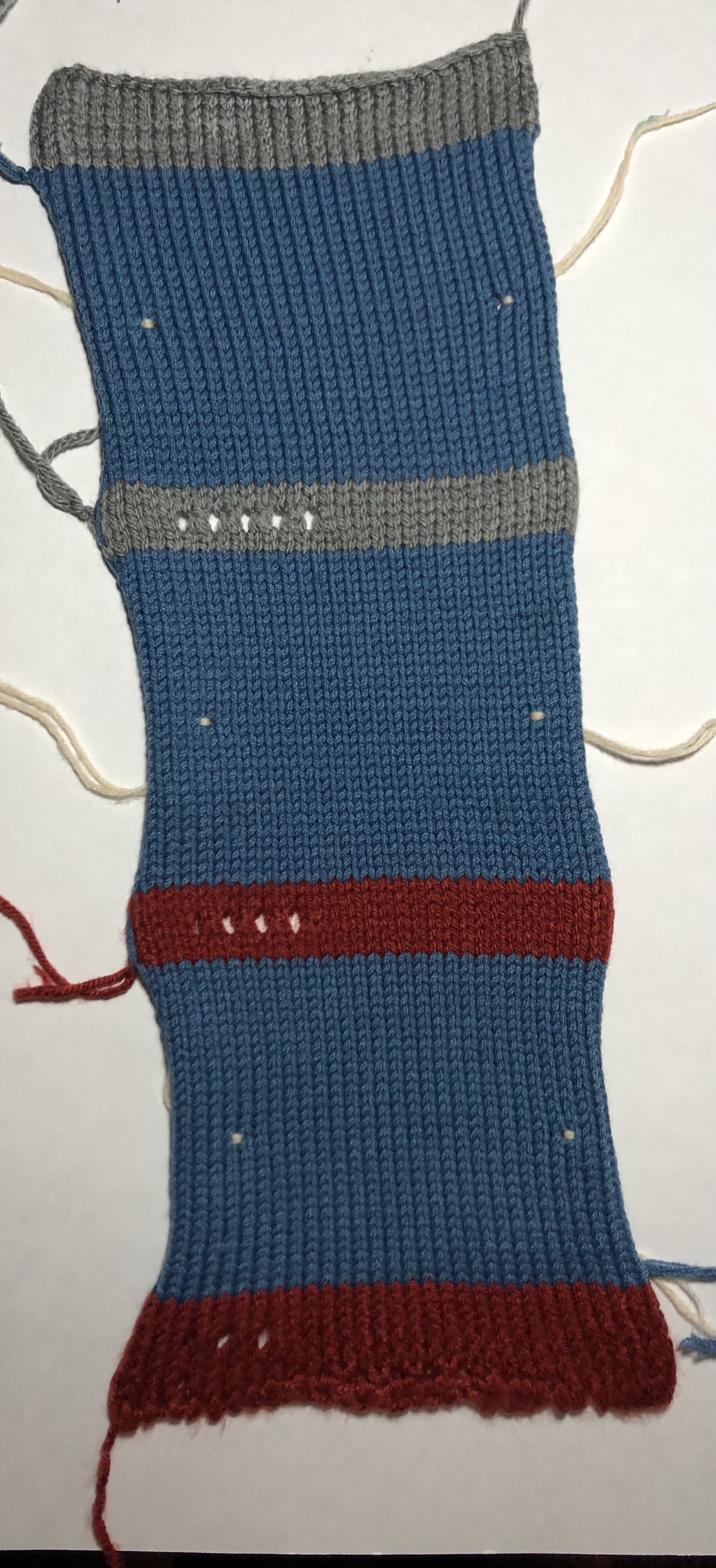
Berroco Comfort Color 9747 “Cadet” knitted at Tension 5 on the SilverReed LK-150 mid-gauge machine

The above swatch was washed on warm, dried on low, and gently steam blocked, not killed, so that there is still some elasticity left in the fabric. Some stitches did catch and pull a bit on other items in my washer, so you should be sure to wash your knits in their own load or in a mesh bag or pillowcase for protection.

Though it is not visible in the picture, some very minor halo or fluffing of the yarn occurred. It has not changed the stitch definition, only added to the softness of the yarn. Garments in this yarn could possibly halo or fuzz more over time, but I have not noticed this in my experience. I have not noticed any pilling whatsoever in my swatches or garments, and my mother tells me she has not had issues with a gifted tank top made from this yarn that she has worn and machine washed for over two years, and she has experienced no fuzzing, pilling, or garment stretching. It should be noted that she does dry the top flat.

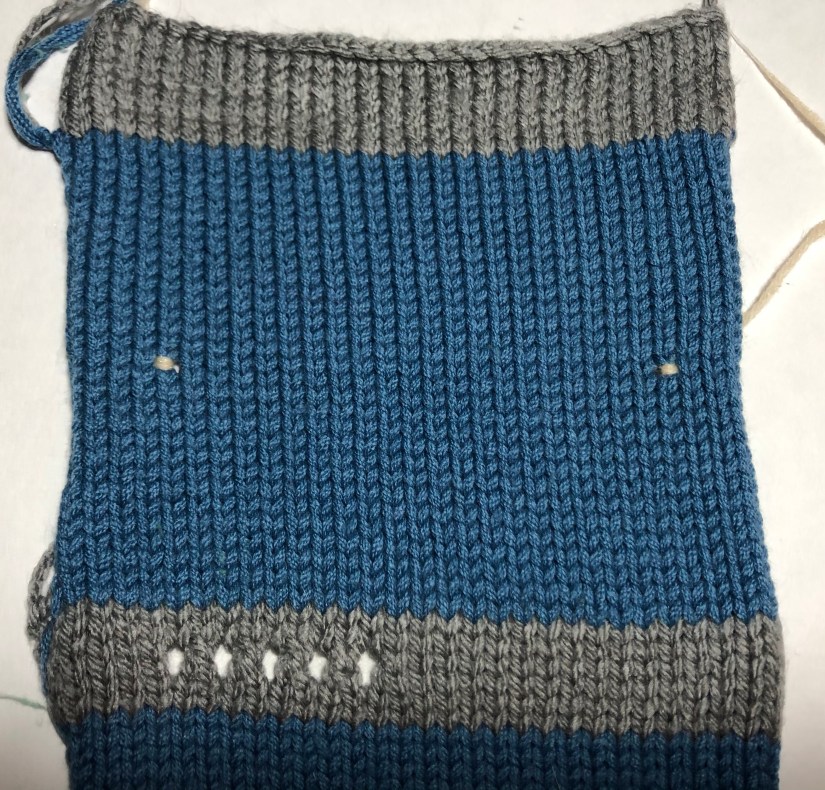
Berroco Comfort Color 9747 “Cadet” knitted at Tension 5 on the Brother KH-890 standard gauge machine

This swatch was also washed on warm, dried on low, and gently steam blocked. I did not stretch it or force it, merely smooth it out from the shape it dried in in my dryer.
Note: Because the LK-150 swatch is an older one from before my current swatch records system, I do not have its before wash measurements to calculate any shrinkage.

Here are the before and after measurements for the standard gauge swatch:

Before After
40 stitches5.875″6″
60 rows6.1875″6″

With only 3% row gauge shrinkage and an actual increase in stitch gauge of around 2%, this yarn does not change much in the wash, but you should always work from your finished swatch measurements in any case.


Blocking

Comfort blocks well with a steam block. I do not “kill” the acrylic with the steam heat, only lightly run the steamer head over the fabric as I move it to the desired dimensions. I do not think this yarn needs to be “killed” to achieve drape or a desirable fabric, especially as the “kill” process slightly melts the yarn, and, I believe, can affect the integrity of the garment. If you do desire or need a more aggressive blocking experience than what I prefer, Comfort can and will meet your blocking desires for the most part without killing the yarn.


Final Thoughts

Comfort performs well no matter what yarn weight you choose. At around $0.03 a yard for worsted weight, you’re looking at a nice, quality acrylic for a good price. A sweater quantity (1000-2000 yards) of this yarn retails for around $35.00 to $75.00, and some shops will give you a bulk buy discount. It’s not exactly a “budget” yarn when you compare it to what you can find at big box stores, but it is definitely worth the price when you consider the quality of what you’ll be running through your machine or your hands and then wearing next to your skin. Plus, when you buy from your local yarn shop, you’re supporting smaller, local businesses, and I don’t think you can go wrong there!

As a sucker for hand-dyed yarns in all kinds of gradients, I usually find myself wishing for rainbow magic colorways in whatever yarn I’m using at the moment, but that isn’t necessary here, and that isn’t what Comfort is trying to do. If you’re looking for a go-to acrylic yarn, Comfort is a great choice.

I’ve used Comfort in tunics, dog sweaters, and scarves, and I’ve seen customers and students use it in baby items, hats, and blankets. If you have a project, you can usually find a Berroco Comfort line yarn that will fit.

I give Berroco Comfort Worsted a solid 4.5 out of 5 score.


Have you used Berroco Comfort before in your machine knitting? What about in your hand knitting? What kind of projects did you use it for, and what did you think of its performance?

Are there other properties you think I should include in my yarn reviews? What yarn should I review next? Let me know in the comments!


Uncategorized

How I Swatch Yarn

There are SO MANY different methods floating around about how to swatch your yarn, but the one I’m about to share with you is the best one I’ve learned yet. It can take a bit of extra time and scrap yarn (let’s be honest, who doesn’t have a ton of scrap yarn tangling around?), but if you keep your swatches (and you should!), you’ll save yourself some trouble in the long run, especially if you find yourself returning to the same yarns over time.

Why this method? Well, do you have Multiple Project Syndrome? I sure do! I often dive into a new project or swatching a yummy new yarn and then end up giving in to the lure of yet another squishy new yarn before I’ve completed using a previous one.

That’s where this method comes in handy–you don’t have to remember anything about the swatch other than what yarn it is! The tension number or knitting needle size, the stitch numbers, the row count? It’s all right there in the swatch itself when you do it this way. There’s no guessing. The eyelets you see in the picture below are a code that tells you what machine was used and what tension the swatch was knitted at! The contrasting scrap yarn marks the beginning and end rows, and the small loops around the stitches in the middle mark the same number of stitches between them every single time.

This method is consistent, and I’ve found it to be the most accurate way of calculating stitch and row gauge because it leaves extra fabric around the area to be measured, which makes for less distortion of the stitches. The contrasting color markers make it easy to immediately find your measuring start and end points.

And this method isn’t just for machine knitters! I use it when hand knitting, too. Instructions are for machine knitting, but a hand knitting summary will follow.

Note: This tutorial does not include how to calculate gauge, only how I swatch yarn.


Drag arrows to see front and back sides of this Jody Long Coastline Color 005 yarn in my swatching style.
Eyelet code marks rows in the bottom of the scrap yarn, and you can clearly see the beginning and end of the main yarn on the purl/wrong side of the swatch.

Materials

  • Main Yarn (to be swatched)
  • Scrap yarn of similar size but contrasting color. It should be able to handle the wash/dry/blocking you plan for the main yarn
  • Knitting machine set to tension of choice with coordinating latch tool, transfer tools, weights, and cast-on accessories
  • Metal, Plastic, or Wooden Ruler (not a tape measure, which can stretch with use and time)
  • Straight Pins
  • Towel or blocking board

Skills Needed

  • Cast On
  • Using Weights
  • Using Transfer Tools to make eyelets
  • Using Latch Hook Tool
  • Switching Yarn Colors
  • Cast Off

How To for Standard Gauge Machines

Cast on 60 stitches with your cast-on of choice in scrap yarn. (L30 to R30 on your needle bed)
Hang your cast-on comb and weights as you normally would.

Knit 2-4 rows.
About 4-6 stitches from the right side edge of the work on your machine, use a transfer tool to make eyelets equaling number of stitches for each number in your machine’s model number, skipping 3-4 stitches in between each number.

Examples:
Make eight eyelets, three plain stitches, nine eyelets, three plain stitches, and then one eyelet for the machine model KH-891.
Make one eyelet, three plain stitches, then five eyelets for the model LK-150.

Knit 2-4 rows.
About 4-6 stitches from the edge, make the number of eyelets that equals the number setting on the tension dial that you are swatching, e.g., five eyelets for Tension 5, eight eyelets for Tension 8, etc.

Knit 2-4 rows.

Switch to Main Yarn.

Knit 30 rows.

Using scrap yarn and your latch hook, secure the scrap yarn around the stitch on needles L21 and R21. There should be 40 stitches between the marked needles. If you wish, pull these stitches all the way out to HOLD position on your machine to ensure they knit.

Knit until you have completed 60 rows in Main Yarn.

Switch to Scrap Yarn.
Knit 2 rows.

*From this point, you may repeat the process from the eyelet row that marks the tension dial number if you wish.*

Knit a total of 4-6 rows after Main Yarn.

Bind off using bind-off of choice.

Measure stitch and row gauges before blocking and record those measurements.

Wash and Block swatch as you intend to wash and block your project. Consider hanging weights (machine weights or fishing line weights work well) to mimic how the bulk of a larger garment might wear.

Measure stitch and row gauges AGAIN after you have washed and blocked your swatch. Record your measurements. Note any shrinkage, yarn performance, and anything you noticed about the yarn along with your measurements.

Always work from your finished swatch measurements.


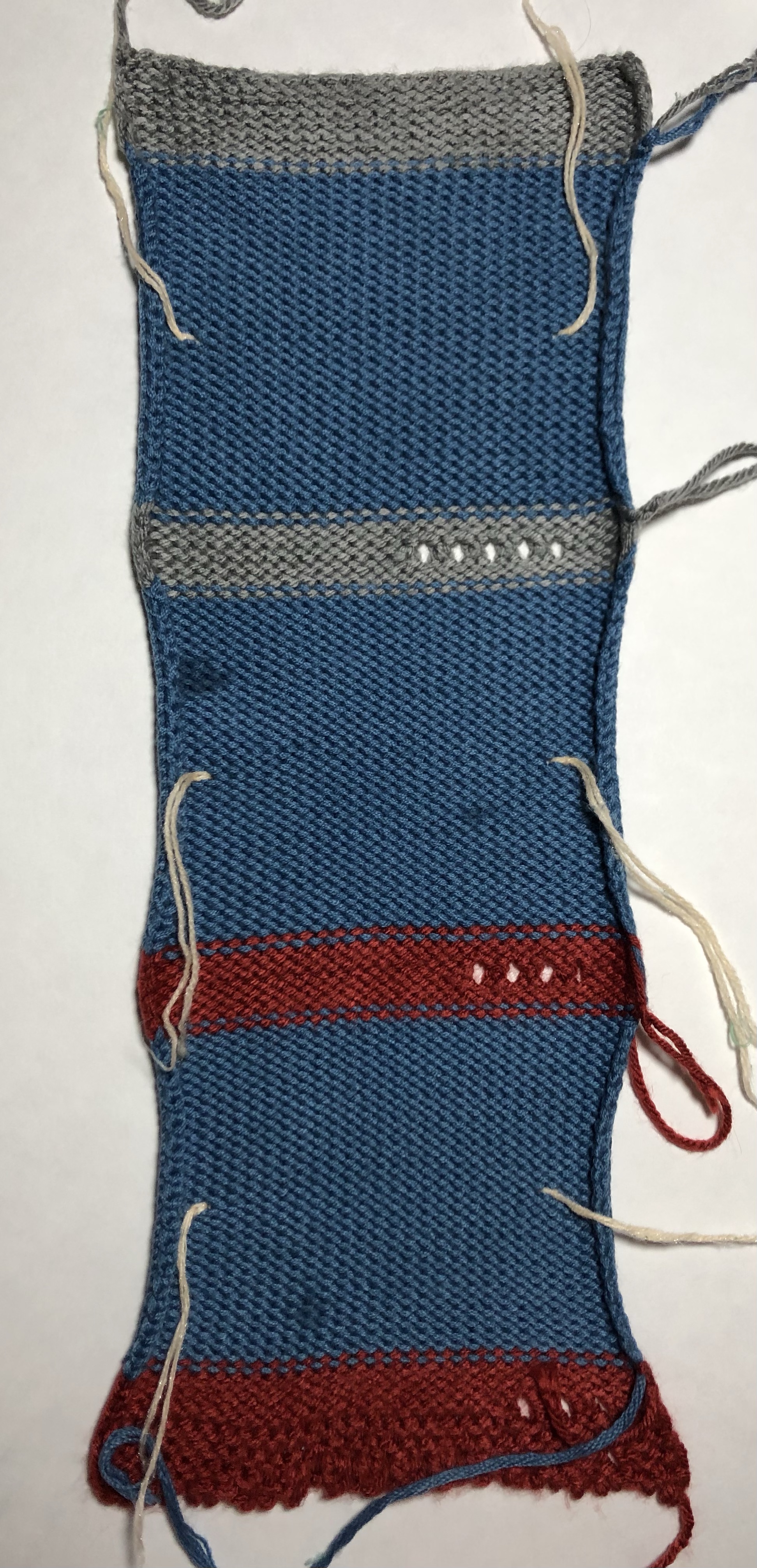
Drag arrows to see the front and back side of connected swatches, or a “security scarf” of gauge.
This yarn swatch is Berroco Comfort in Color 9747 “Cadet.”
You can see eyelet rows denoting tension size changes in the red or grey scrap yarn between the blue main yarn.
You can see wrapped stitches denoting 20 stitches between markers.
(I apologize for the messy cast on that obscures the machine model number code row. This was knitted on the LK-150.)

Measuring Your Swatch

Gather your swatch, straight pins, ruler, and blocking mat or towel.

When you measure, your swatch should be on a flat surface and unstretched. Pin it to the blocking board or towel for stability so it will not move while you measure, but don’t stretch it out.

Stitch Gauge:
Measure with the knit side of the fabric facing up.

The stitches wrapped in scrap yarn always denote 40 stitches between them for standard gauge swatches or 20 for mid-gauge and bulky swatches, but the wrapped stitches can distort the stitches next to them a bit. Simply move your ruler a couple rows down and measure between the marked stitches.

Record your measurements! I use a binder. Some people prefer to write notes in their ravelry.com yarn stash pages. Whatever you do, keep a record of your measurements.

Keep your swatch! Do you need to meet a specific stitch gauge from a hand knit pattern that you’re translating to the machine, but it’s given over a different number of stitches? Just count them out on your swatch and go from there!

Row Gauge:
Re-pin your swatch with the purl side of the fabric facing up. Do not stretch out your swatch. You can clearly see the purl bumps of color where the main yarn begins and ends. Using your ruler in the middle of the swatch, measure from the start of the main color purl bump to the last of the main color purl bump.

Record your measurements and keep your swatch! This is so helpful in the long run, so I will keep stressing this!


Drag arrows to see the front and back sides of this swatch. Yarn is 316 Dye Studio’s House DK in Spruce.
As you can read from the code rows’ eyelets, this was knitted on the LK-150 at Tension 5.

How To for Mid-Gauge and Bulky Gauge Machines

Cast on 30 stitches with your cast-on of choice in scrap yarn. (L15 to R15 on your needle bed)
Hang your cast-on comb and weights as you normally would.

Knit 2-4 rows.
About 3-5 stitches from the right side edge of the work on your machine, use a transfer tool to make eyelets equaling number of stitches for each number in your machine’s model number, skipping 3-4 stitches in between each number.

Examples:
Make eight eyelets, three plain stitches, nine eyelets, three plain stitches, and then one eyelet for the machine model KH-891.
Make one eyelet, three plain stitches, then five eyelets for the model LK-150.

Knit 2-4 rows.
About 3-5 stitches from the edge, make the number of eyelets that equals the number setting on the tension dial that you are swatching, e.g., five eyelets for Tension 5, eight eyelets for Tension 8, etc.

Knit 2-4 rows.

Switch to Main Yarn.

Knit 15 rows.

Using scrap yarn and your latch hook, secure the scrap yarn around the stitch on needles L11 and R11. There should be 20 stitches between the marked needles. If you wish, pull these stitches all the way out to HOLD position on your machine to ensure they knit.

Knit until you have completed 30 rows in Main Yarn.

Switch to Scrap Yarn.

*From this point, you may repeat the process from the eyelet row that marks the tension dial number if you wish.*

Knit 4-6 rows.

Bind off using bind-off of choice.

Measure stitch and row gauges before blocking and record those measurements.

Wash and Block swatch as you intend to wash and block your project. Consider hanging weights (machine weights or fishing line weights work well) to mimic how the bulk of a larger garment might wear.


How To Modifications for Hand Knitting

Skills needed:
Cast on
Knit
Purl
Stockinette stitch
Yarn Over (YO)
Knit 2 together (k2tog)
Bind off

Instructions:
With scrap yarn, cast on 30 stitches.
Knit 2 rows in stockinette stitch.
On the Right Side or Knit Side of the swatch, perform a “Code Row” by creating the number of eyelets that equals your knitting needle size.
For example, on a size 6 needle:
Knit 4 stitches, (YO, k2tog) six times, and knit to end.
Knit two more rows in stockinette stitch.
Switch to Main Yarn.
Knit 15 rows. Use a small piece of scrap yarn to mark the fifth and twenty-sixth stitches by wrapping them with the waste yarn and looping it on itself or tying it in a knot around the stitch.
Knit 15 more rows for a total of 30 rows with main yarn.
Switch to Scrap Yarn. Knit 2 rows or Repeat from “Code Row” with another size needle.
Bind off.


Notes

Feel free to fiddle with the number of scrap yarn rows in between your main yarn as long as you leave some space around the eyelet rows to allow for any distortion they might cause in your fabric. Sometimes I will knit more rows and sometimes I want to do as few as possible.

If you’re working with a limited amount of yarn, you can always unpick your swatch and use it, but you should try to buy enough yarn to keep your swatches as reference. If you’ve recorded your measurements in a safe space, I suppose you don’t have to keep your swatch around if you don’t want to.

I store my swatches in an old Lebkuchen-Schmidt Nuremburg tin, but you could graft your swatches together to make pet shelter blankets or use them for coasters if you know you’ll never need them again. (Oh the sadness of discontinued yarns!)


How do you swatch on your machine? Do you use this method or something similar? Do you save your swatches? What about favorite yarns? Are there any you return to that would benefit from swatching this way? Let me know in the comments!

Credits and Sources
Pamela Carrico of CMO Designer Knits— my knitting machine teacher, mentor, and friend.
Diana Sexton Designs of Lafayette, IN– handout packet pages 57-58, “Security Scarfs.” I was unable to locate an online presence.
“How to use your Knit-Leader” KL-116 manual, page 7. You can find various machine and accessory manual PDFs at machineknittingetc.com.

Uncategorized

Review: Machine Knitting Monthly – February 21 – Issue 277

Welcome to the first of many review posts! Today we’re looking at the February 2021 edition of UK-based Machine Knitting Monthly. This post will also be a bit of an overview of what the magazine has to offer.

I’ve been a subscriber to this magazine for over a year, and it’s one of the only machine knitting magazines left. It costs around 10 USD including shipping, and it generally arrives towards the middle of the listed month for me. (For a US-based mag, check out Country Knitting of Maine’s News & Views magazine.)

What’s in this issue?

First up, let’s look at Machine Knitting Monthly’s regular setup. You can expect an average of eight patterns per issue, and newer issues include instructions and/or conversion factors for both standard and mid-gauge machines. All patterns feature a schematic, so if you do the knitting math, you can knit them out of whatever yarn you like on your choice of machine.

You’ll find features on fashion in the “Style File” if you’re looking for inspiration, quick craft book reviews, and the magazine’s own letter section, “Dear Anne,” where you can see what other readers are working on and where they’re having issues. I love to see what others are working on, and I feel solidarity and a bit of encouragement when I read of others’ struggles and the solutions offered. For a sense of community, this magazine section is my go-to, especially during the pandemic.

The magazine has been on a self-striping yarn kick for about four issues now, and while I’m ready for them to move on to something new, they’ve managed to pick some pretty decent patterns that show off self-striping yarn well, as seen in the cover’s main feature, the sweater Cold Comfort.

Machine knitting instructor, designer, and author Susan Guagliumi has been a regular in recent months. Her book, Hand-Manipulated Stitches for Machine Knitters is a MUST HAVE for all machine knitters in my opinion. This month’s contribution is a Fair Isle colorwork cardigan. The pattern supplies a punch card template, but don’t worry if your machine doesn’t have punch card capabilities. You can hand-select the needles for this pattern and achieve the same result.

February 2021’s Designer Spotlight shines on Alison Dupernex and features a look at her use of color choice and textile design. I particularly enjoyed the visual textures created by her included pattern, Tiger Stripe.

Machine Knitting Monthly’s own designer, Bill King, regularly features techniques in his column. This month’s, entitled “Lean on me,” features leaning cables and eyelets made by using groups of needles and short-rowing techniques. (You can see an eyelet version of this element used in Linda Jensen’s Serpentine Shawl pattern on etsy.) This issue also includes a reprint of Bill King’s Fandango design.

Most patterns and techniques are designed for Silverreed/Brother/Knitking-style machines, but Machine Knitting Monthly now features a regular section called “Passap People” with techniques especially for Passap machine users.

The magazine also reprints a column with the conversational wisdom of the late Joan Lafferty.

You’ll see standard advertisements, but these are better because many of them are machine knitting and cone yarn related. You’ll often find discount codes for subscribers, so that’s a nice plus!

Thoughts

It’s been a few years since I started machine knitting, but I’m still eating up any form of machine knitting media I can find. Since this is one of the few print media machine-related things still around, I subscribed as soon as I found out about Machine Knitting Magazine and it fit into my budget. Sometimes I think I’m still in the honeymoon phase of machine knitting where everything seems gloriously and intimidatingly possible. If it exists for machine knitting, I want it, and I will do what I can to throw money at it and support it. As they say on their cover, Machine Knitting Magazine has been around for 34 years, and I’d like them to be around for many, many more.

That being said, the magazine’s patterns can really suffer from that vintage feeling that a lot of machine knitting has floating around it. The patterns may use newer, flashier things like self-striping yarn, but a lot of them feel like those same classic patterns from the vintage books. (I don’t mean to pooh-pooh vintage patterns. Classic shapes are classic for a reason, so hoard those vintage pattern books when you find them. I definitely do.)

I’m a thirty-something American, so I’m pretty sure I’m not Machine Knitting Magazine’s target audience. I’ve heard people lament it’s a dying art in the USA. Many of the machine knitters I attended seminar were past their fifties and sixties, but many were younger. Gen X and Millennial machine knitters do exist! But where do they get their patterns?

I’m an avid ravelry.com user, so when I compare the pattern feed of ravelry to what’s showing up in Machine Knitting Monthly, the magazine comes up short on color choice, stitch usage, textures, and garment variety. It’s difficult to find a lot of their patterns even listed in ravelry’s database (although you and I can submit them and change that fact since the database is user generated).

Comparing a monthly magazine to an internet pattern database and social platform is not a fair comparison whatsoever, but it highlights what I personally would like to see in the magazine — more variety.

But therein lies the rub– ravelry has an abundance of designers and content creators, while many of those who would do so for machine knitting have retired or passed away. Many are of an age that generally just isn’t tech-savvy.

So where does that leave us? It’s up to the machine knitters of today to create that variety and get it out there so others can see it and we can grow our craft. ravelry.com has a machine knitting section, so there’s a place right there in the biggest yarn community on the internet for us.

Pulling back from that ranty tangent and getting back to the magazine review, I truly like but also dislike that Machine Knitting Monthly will rerun patterns and columns. On one hand, a rerun means that something that might have been published before I could even read will reach my eyes, but on the other, a reprint makes me wonder again about lack of content.

The technique sections are inspiring, and I enjoy the friendly tone of the late Joan Lafferty’s column reprints. I enjoy that window into the machine knitting world of the past.

Machine Knitting Monthly has great picture tutorials– this month’s focuses on invisible seam grafting/Kitchener stitch, something I just could not grasp until I saw the way many machine knitters graft — off of waste yarn, so it might be handy to those of you who still need assistance with seaming.

So, with all of that said, let’s deliver some sort of rating.

Simply for existing, Machine Knitting Monthly itself gets a 5/5.

Because of the continued insistence on self-striping yarn and lack of variety in patterns but extremely helpful tutorials with great technique highlights, February 2021’s Issue 277 gets a solid 3.5/5 from me.


I hope you enjoyed today’s review. Do you subscribe to Machine Knitting Monthly, too? What did you think of this month’s issue? What did I miss in this review that you’d like to see? Let me know below in the comments!


I am not affiliated with any of the individuals listed or linked here unless otherwise noted. All opinions are honest and my own.

Uncategorized

So you’ve inherited a knitting machine… now what? Starting from Scratch with Machine Knitting.

There are so many things to consider when you find yourself with a knitting machine. What even is it? It says it’s a machine that knits in the name, but how does it do that? What if you don’t hand knit? Where do you find the yarn? How much space is this thing going to take up in the house?

If no one around you knows anything about machine knitting, you’re going to have to do the work yourself to track down the resources (and I’m here to help!). But before you start going crazy with all of the questions a potential new hobby brings, it’s time for the first significant stop in your knitting machine journey.

It’s not Google. It’s YouTube.

Googling your new hobby is a great way to find articles and inspiration, but you’ll often find yourself in too deep and overwhelmed by knowledge and terms when you dive head first into forums and specialized sites. You’ll get there in machine knitting, too, since that initial overwhelmed feeling can happen with every hobby, but stopping and watching first can help you catch your breath.

Take the time to see the possibilities in machine knitting. Try not to let any terms catch you off guard, and make a mental note of anything that catches your interest for later. Remember, you’re just watching for now.


Here are a few videos to get you started:

Machine Knitting a Sweater – Time Lapse by Lorna Watt – Start to finish of a cat sweater

Fruity Knitting Podcast Episode 105 – Interview with machine knitting instructor Susan Guagliumi – This episode is especially good for hand knitters wondering about machine knitting. In addition to a two part interview with Guagliumi, Fruity Knitting interviews a hobby machine knitter who does not hand knit.

Brother KH-860 Knitting Machine Demo by Buckwsr – sampling of many different knitting machine functions


What do you think? Were you inspired? Intimidated?

Machine knitting does have more of a learning curve than hand knitting or other yarn crafts, but don’t let that discourage you. Watching others work will open your mind to the endless possibilities of the craft.

If the dive into machine knitting does become too much, remember, there’s a pause button, and you can always come back later. Those of us in the machine knitting community will be happy to have you join us whenever you’re ready.


Where did your YouTube machine knitting video dive take you? Share some of your favorites in the comments below!

If you’re an experienced machine knitter who didn’t have YouTube when you began, where did you start?