Tips and Tricks

Finding Cone Yarn

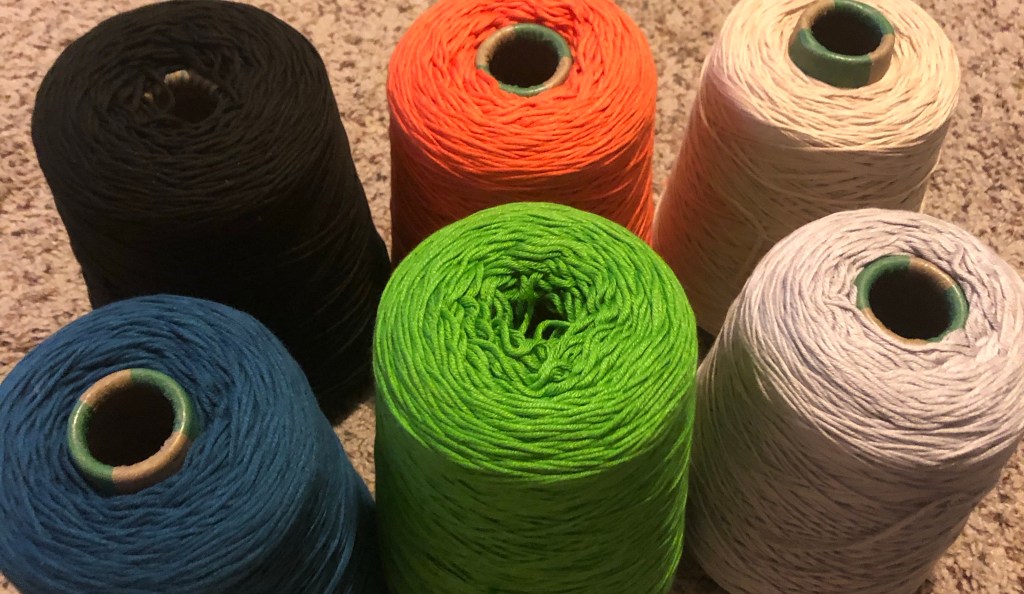
Knitting machines can use a range of yarn from all kinds of put-ups like we saw in my last post, but the easiest and best put-up for machine knitting is cone yarn. Cones donโ€™t need extra preparation before use, have more yardage in general, and often feature unique textures or colors that you might not find in hand knitting yarns.

If cone yarn is so great, why is it harder to find?ย 

In the USA, machine knitting isnโ€™t as common as it once was. While the hobby is growing again, itโ€™s kind of seen as a niche within a much more popular one or even as โ€œcheatingโ€ at hand knitting. Yarns made and wound on cones specifically for machine knitting arenโ€™t really a thing here anymore.ย 

On the retail side, cones are larger and more difficult to display compared to other put-ups. Most shops donโ€™t have the shelf space to dedicate to a few 1-2lb cones that would otherwise be filled with 10-15 skeins or hanks. Many hand knitting or crochet projects donโ€™t need the thousands of yards that can come on a cone. Additionally, shipping cones generally costs more for the number of products you get than other, smaller put-ups.ย 

The downsides of retail shouldnโ€™t keep you from using cone yarn in your machine knitting.

Let me butter you up a bit, reader. If you’re a machine knitter, you already work harder to find your materials, parts, and resources than other yarncrafters have to because of that niche! A little work to find cone yarn is nothing to you, right?


Finding Cones Locally

Iโ€™m a big believer in shopping at local small businesses whenever possible.

So please, 

Check Your Local Yarn Shop

Maybe they have cone yarn and you missed it! Itโ€™s easy to get distracted among the beautiful colors and textures in a yarn haven. Trust me, I understand.ย 

If your local yarn shop doesnโ€™t stock cone yarn, ask them about it!

Most shops are happy to accept special orders.
**Please keep in mind that many distributors have a minimum dollar amount to place an order for new accounts, so it may take your LYS time to reach that amount depending on their size.ย Pay up front and work with your local shop so you both benefit! Convert your yarn friends so more of you need cones! (No downsides to that one, right?)

Get Stitchinโ€™, the shop where I teach lessons, recently became an Ashford dealer. Now they have 0.5lb Ashford cotton yarn cones alongside their Ashford spinning wheels and looms! Those gorgeous yarns work wonderfully on 4.5mm standard knitting machines.ย The owner is happy to order other yarns in, too. I just have to ask!

Oh, speaking of looms,

Ask the Weavers!

Ask your weaving friends or your region’s weaving guild where they source their coned yarns. Many of them will use hand yarns, but those who work with finer yarns will often use cones. (If you donโ€™t have any weaving friends yet, try to make some! Weavers are fun!)

Chat with the Regulars

I live in rural Oklahoma. Most people probably think of Native Americans and buffalo when they think of the state. They definitely don’t think of yarn.

That doesnโ€™t mean hand or machine knitting doesnโ€™t exist here, it just means I had to look a little harder than someone in a big coastal city or European town might’ve had to.ย 

As some of you know, I used to work at a yarn shop in the suburbs that focused on hand knitting and crochet. When my hands started to deteriorate (I talked about it in this post), I had to start looking for other yarn craft options.

I saw Addi circular machines online, but I had never heard of a flat bed knitting machine. I mentioned my machine research once at the old yarn shop with the other regulars, and wouldn’t you know, one told me about the Fiber Christmas In July festival, a wonderful local fiber festival, and a vendor there who specializes in machine knitting!

Who knows how long it wouldโ€™ve taken me to figure things out if I hadnโ€™t stuck around and chatted with the yarn shop regulars?!

My teacher and mentor Pamela Carrico is the fiber artist specializing in machine knitting that customer told me about. Her shop has both hand knitting yarns and machine knitting cone yarns! She has new old stock vintage yarns as well as quality acrylic 2/24 yarns that she sells by the pound, which is really helpful if you want to do a colorwork project but you donโ€™t want to pay for pounds of yarn colors you may only use once.ย 

Asking around helped me find an instructor and materials in one place!


Things worked out wonderfully for me, but what if you don’t have a local yarn shop or yarn community? Making your own is always an option, as is joining an online one.

If you donโ€™t have a local yarn shop, please consider finding a small business online and supporting it before you turn to a big box store. Youโ€™re more likely to find someone who can really help you find what you need at a small specialty shop, too!

Call (Yes, Call) Other Yarn Shops 

I have the Millenial Aversion to Phone Calls. If youโ€™re not a close friend or family, I much prefer text or email, so I understand there can be some discomfort in this tip.

But remember, many machine knitting shops have been in business for decades, meaning they have operated without texts and emails for a long time, so a phone call is going to be your best option, especially as they take care of things in store. Donโ€™t forget to leave a message if you need to. Save the shopโ€™s contact information so you know they arenโ€™t spam when they call you back. (Yes, youโ€™ll have to answer the phone, too!)ย 

At the bottom of this post, you’ll find a list of shops that I know stock machine knitting cone yarn in the USA. If you know of more, let me know in the comments!

Some of these shops don’t have cone yarn listed on their websites but can tell you what they have when you call and ask. Many have “dead stock,” or discontinued cone yarns that are still perfect for knitting. They just aren’t made anymore.


Online Marketplace Listings

If you weren’t able to find anything with info from your LYS or yarn friends, try using Google, Craigslist, and Facebook searches for โ€œ<your location> cone yarnโ€ or โ€œ<your location> machine knitting.โ€ Donโ€™t forget to check Facebook Groups that may meet locally or regionally, either!ย 

Cone yarn is often listed in large lots from estate or garage sales. Since it takes up so much room, many people are happy to meet you somewhere and give you the yarn for an extremely low price or even free.ย I’ve found yarn like this several times. It’s worth checking regularly.

Set a search alert using machine knitting and cone yarn terms so youโ€™ll know when something near you pops up. When you pick up your yarn, ask the seller about their source or where they learned about machine knitting and cone yarn. 


If your local search doesn’t pan out, try some of these smaller businesses online:

Cone Yarn Stockists

Carrico’s Creative Cornerhttps://www.cmodesignerknits.com/Cone Yarn by the Lb, old stock, and more!
Knitcrafthttps://knitcraft.com/SilverReed Importer
The Knit Knack Shophttps://knitknackshop.com/ Tamm Yarns
Peter Patchis Yarnshttp://peterpatchisyarns.com/Email list of Specials
The Yarn Depothttps://yarndepot.orderpromos.com/LARGE cones
Rocking Horse Farmhttps://www.rockinghorsefarmknitshop.com/Machine Knitting Camp
Get Stitchin’https://getstitchin.com/ Ashford Dealer
Ashford Yarnshttps://www.ashford.co.nz/Find local dealer!
WEBS Yarn Storehttps://www.yarn.com/Valley Cone Yarns
YARN ITALYhttps://www.etsy.com/shop/YARNITALYGreat Variety
Silk City Fibershttps://www.silkcityfibers.com/“Wholesale” price
Paradise Fibershttps://paradisefibers.com/collections/coned-yarnFree Shipping after $150 Lower 48
The Wooleryhttps://woolery.com/Weaving Yarns

Have you tried machine knitting with cone yarn yet? Were you able to source it locally? What are you planning to make? Let me know below in the comments!

Disclosures:

I teach hand and machine knitting classes at Get Stitchinโ€™ in Tulsa, OK. Iโ€™m not paid to promote the shop, but things that benefit the shop often benefit me as peopleย may purchase my work from the shop or sign up for one of my classes!ย 

Carricoโ€™s Creative Corner is my mentorโ€™s shop. I’m not paid to promote her shop, but I happily mention it to support her and her work. ย 

Shops listed are provided for informational and educational purposes and are not affiliated with me.

Thanks for joining me on my machine knitting journey! I hope you learned something useful today. 

logo created by the lovely Mimolette Monster

Tips and Tricks

Your YARN is the Problem โ€” Part One: Hand Knitting Yarn Prep

You might have encountered one of these problems before: the yarn stopped flowing through the tension unit and the tension wire bent all the way towards the carriage and needle bed, the carriage jammed, an entire row knitted at a much tighter tension than you wanted, the yarn broke. 

If you are experiencing problems when you machine knit with hand knitting yarn, your yarn preparation (or lack of) might be the problem. Here are some things to consider about different yarn put-ups and the ways they can affect your tension while knitting. 


Hank
Must be wound into ball or cake before use

Donut
I absolutely hate the donut put-up, so I’m going to rant about it!

It does nothing other than look pretty on a shelf. Hand knitting will cause it to fall apart. Putting it in your bag after purchase will cause it to fall apart. Looking at the outer layer cross-eyed will start it on its slinking, unwinding, collapsing journey!

Unstable put-up
Uneven tension
Needs to be contained
Flops around

Yarn Ball
Can roll away
Needs to be contained in a basket or bucket
Yarn can get caught under the weight of large balls causing uneven tension

Skein
Center pull often results in “yarn barf” and/or collapsing skein
Needs to be contained
Outside pull means flopping/traveling/rolling skein and uneven tension as yarn enters machine
Outside pull means stopping after a row to pull out enough yarn to knit a row every time to avoid flopping

Cake
Manual-recommended put-up for Silver Reed LK150
Flat top and bottom
Should not roll
Most even tension of all put-ups mentioned so far
Require ball winder and swift

Cone
Best put-up for machine knitting
Even tension
Large yardage
Not a commonly used put-up for hand knitting yarn


You aren’t an awful knitter if you don’t knit from yarn cakes or cones! But they are the best put-ups that are least likely to cause issues.

I’ve knitted center pull from a skein before. Everything turned out fine, but I did have to stop and fix a few tension issues as I knitted.

I knit from yarn balls all the time, especially for scrap yarn. Sometimes they jump out of their container when I’m knitting quickly and I have to chase them down. It happens.

Knitting from less than ideal put-ups just means I accept I might encounter problems and have to fix them.


A Note on Yarn Cakes

Ideally, yarn winders should wrap around the sides of the cake and not on top or bottom.

If your yarn winder wraps the yarn around the sides and over the top and bottom, the cake will flop and turn like a yarn ball and add additional tension as it does. This is not an ideal cake for machine knitting, but you can make it work by pulling yarn out periodically so it doesn’t have to flop and roll.

Flopping that happens to an “ideal” cake that isn’t wound over the top/bottom likely means there is not enough lead length of yarn from the cake to the tension unit to the carriage (such as the yarn sitting on the table instead of the floor behind the machine), so be sure to give your yarn ample space as it feeds into the tension unit.


Finding Cone Yarn

There are many places to find cone yarns online, but PLEASE visit your Local Yarn Shop first!

If they donโ€™t have any cones, just ask. Most shops are more than happy to custom order yarns. (Just remember some distributors have minimum orders and it might take a bit to meet that number!) And if you don’t have a yarn ball winder and swift, most LYS will wind the yarn you purchase there into cakes for you.

My Local Yarn Shop, Get Stitchinโ€™ in Tulsa, OK just became an Ashford dealer! I donโ€™t weave or spin much, but do you know what comes on cones? Weaving yarn!

(Disclosure: I teach classes, sell Silver Reed knitting machines, and sell my work at Get Stitchinโ€™, but Iโ€™m not paid to promote it. I mention it because I both sell and shop there.)

Carricoโ€™s Creative Corner in Bartlesville, OK, my mentor Pamela Carricoโ€™s shop, has a wonderful array of cone yarns as well as hand knitting yarns. Pamela sells cone yarn by the pound, which is a great option for knitters who donโ€™t want to commit to an entire cone and thousands of yards of one color. She also often has new old stock of discontinued yarns that were made especially for machine knitting.


In the end, the amount of preparation you do when machine knitting with hand knitting yarn is about what youโ€™re willing to put up with. You may be willing to deal with a ball rolling around or unwinding from the outside of a skein before knitting every row, but if you find yourself constantly encountering tension issues and uneven knitting, look to your yarn put-up and preparation first.

Thanks for coming along on my machine knitting journey! How do you prep your yarn? Are you strict about it, or do you knit from whatever you feel like using at the time? Let me know in the comments!

Knitting Machines, tutorial

Yarn Plating and the SilverReed LK150

Have you heard of plating? Not metal plating- yarn plating on the knitting machine!

Most knitting machines can plate with an attachment or interchangeable carriage piece, but plating is a built-in carriage capability on the Silver Reed LK150 6.5mm mid-gauge machine.

It’s described in the manual as two different yarns knitted together where

one yarn appears on the knit side while the second yarn appears on the purl side of the knitting

SilverReed LK150 Instruction Manual p22

The yarns are usually different weights and fibers with one giving additional support to the construction of the fabric and/or adding special visuals like the swatch below.

(If you really want to dive into the technicalities, check out section 6.8.3 Plating in Knitting Technology by David J. Spencer. I thought it was a fascinating read!)


rainbow rayon thread plated on the knit side over a wool dress yarn purl side

Adding Structure – My AHA! Moment

The swatch above uses a very thin, thread weight rainbow rayon yarn over a wool dress yarn of about fingering weight to create a fabric that couldn’t exist without utilizing plating. But how did I get there?

When I was a machine knitting beginner, my friend gifted me THREE CONES of thread weight rainbow rayon yarn. It’s lovely. I adore the colors.

But…

The yarn is so thin that I found it difficult to work with on a standard 4.5mm gauge knitting machine. It’s just too small, and I had no clue what I could make with it. Perhaps a light shawl, but I didn’t think that would work.

Plus… rayon isn’t known as “the poor man’s silk” for nothing. It has a smooth texture and a lovely drape. But that drape comes with drop sometimes. Rayon knits can stretch in length under their own weight, and that can create some fit issues like armholes dropping or skirts falling to an undesired length.

So rayon isn’t always a good choice for some projects unless you combine it with another fiber and use it in a blended yarn, but I already had yarn that was 100% rayon with no clue what to do with it…

That’s when my teacher and mentor Pamela Carrico of CMO Designer Knits introduced me to plating. She gave me the wool dress yarn and suggested plating my rainbow rayon yarn on top of it.

It’s. Perfect.

The wool yarn grants elasticity and memory to the fabric and gives it structure due to the way wool fiber clings to itself at the microscopic level with tiny scales. That wool yarn basically negated rayon’s inherent issues.

The wool is about fingering weight and was much more manageable than thread for me as a beginner. The fabric it created was still nice and lightweight, so that meant it was still wearable while being wool, which matters in Oklahoma.

A “what the heck” yarn turned into “this works perfectly” in an instant.

Visual Appeal

The wool yarn has a blush pinkish grey appearance that doesn’t photograph well and didn’t stand out much on its own. As someone attracted to color, I would have passed it up if Pamela hadn’t suggested it.

She knew that rayon needed structure, and she knew my particular rayon didn’t need more color.

Adding the rayon to the wool took it from slightly boring to amazing. The wool didn’t really need anything, but the rainbow colors helped it make a complete fabric.


You won’t always have yarn features or issues to work around like I did, but you might find yourself wanting something more from your yarn, and plating offers that, too.

Lurex metallic yarns are easy to find on sites like Etsy, but sparkle isn’t all you can add to your work. Bouclรฉ yarns add both visual interest and texture to your fabric. The possibilities are nearly endless.

So if you find yourself with a yarn that just doesn’t work on its own, try plating with it!


Plating Issues

Perfect plating places the yarn on the correct side every time, but for me on my standard gauge machine, that meant very careful carriage pushing and checking every row after it was knit. Even then, it didn’t always come out as planned.

rayon rainbow thread yarn on fingering wool dress yarn

If you look closely, you can see plenty of rows where the wool came through on the purl side and the rainbow rayon came through on the knit side. I wanted the rainbow on the purl side and the wool on the knit side for this swatch, but that just didn’t happen.


So where does the LK150 come in?

So far I’ve only discussed my experience with plating on a standard 4.5mm machine, but that’s not what the title said this post was about!

In my personal experience, I have not had the issues with yarns visiting the incorrect side of the fabric when I use the LK150 for plating. Instead of using an interchangeable part, the plating feature is built into the carriage, and I believe this is what makes it a more “stable” plating option.

For the smaller “top” yarn, I’ve used the thread rayon yarn, lace weight yarns, and even sock weight yarns on top of fingering and DK weight yarns. I even attempted plating two fingering weight yarns, which worked, but it wasn’t quite as nice of a fabric as the other combinations.

While preparing this post, I tried running the carriage across the needle bed very quickly, and I still did not experience yarns hitting the incorrect side of the work. This may not be universal and my machine’s younger age (about 3-4 years) might matter. I’m not complaining!

Plating takes yarns that might not be suitable on their own for your machine and makes working with them possible.


How to Plate on the LK150

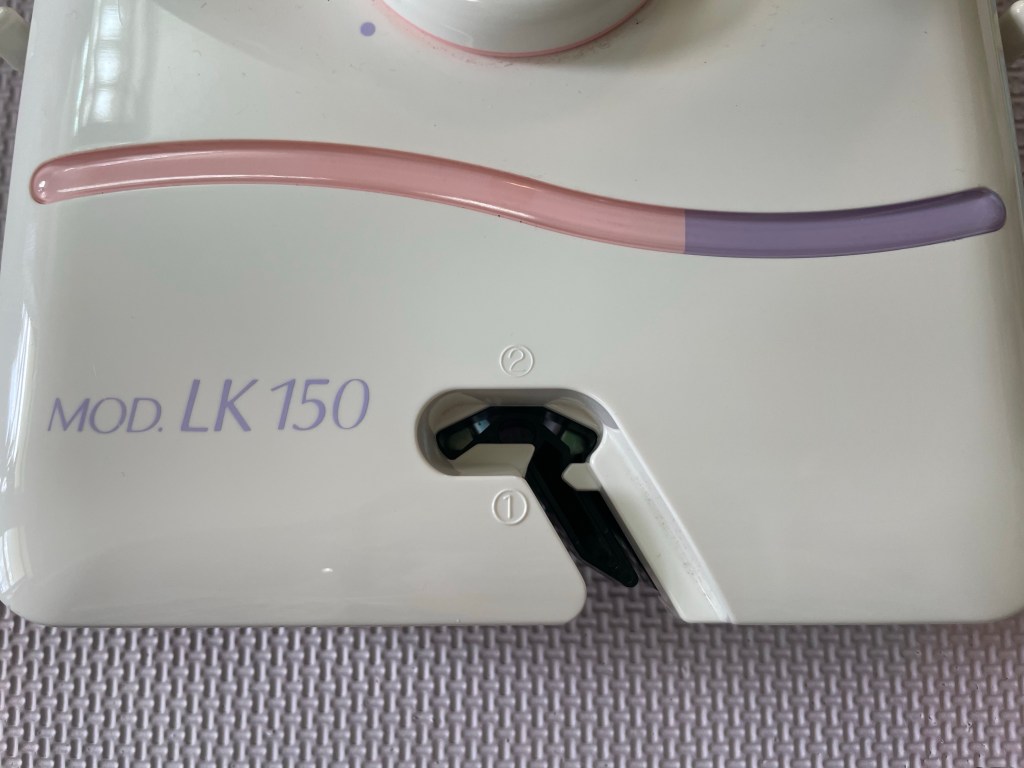
Thread one yarn into slot 1, thread a second yarn into slot 2 and knit the night away!

That’s all it takes, but you should also make sure the yarns are not close to each other where they might twist or static cling to each other as they feed through the tension unit and carriage. Twisting two yarns together can make an interesting fabric, but that is not what we want in plating.

I can never remember which slot places yarn on the knit side and the purl side, so the first row of my swatches is often opposite of what I intended.

I’ve written it all out here so you won’t have the same problem! I’ll refer to the smaller yarn as the plating yarn.

slots 1 and 2 from the top
slots 1 and 2 from the front, angled upward

If you want your plating yarn to show on the purl side, thread it into slot 2 of the carriage.

If you want the plating yarn to show on the knit side, thread it into slot 1 of the carriage.


Once your carriage is set, swatch for tension and knit as usual!

I really do mean โ€œknit as usual.โ€ You can short row, cable, increase, decrease, and transfer stitches as you normally would while yarn plating.

You will want to be careful about where each yarn sits on the needle with any laddering and latching up to form purls for ribbing or texture stitches. The yarns need to stay on their respective sides of the knit fabric.

The same goes for stitch transferring and fixing dropped stitches. Make sure you catch both loops of yarn and re-hang them in the right orientation.

What do you think? Have you tried plating yarn before? Do you think you’ll try it now on the Silver Reed LK150? Let me know in the comments!

As always, thank you for reading and coming along on my machine knitting journey!

Seminar

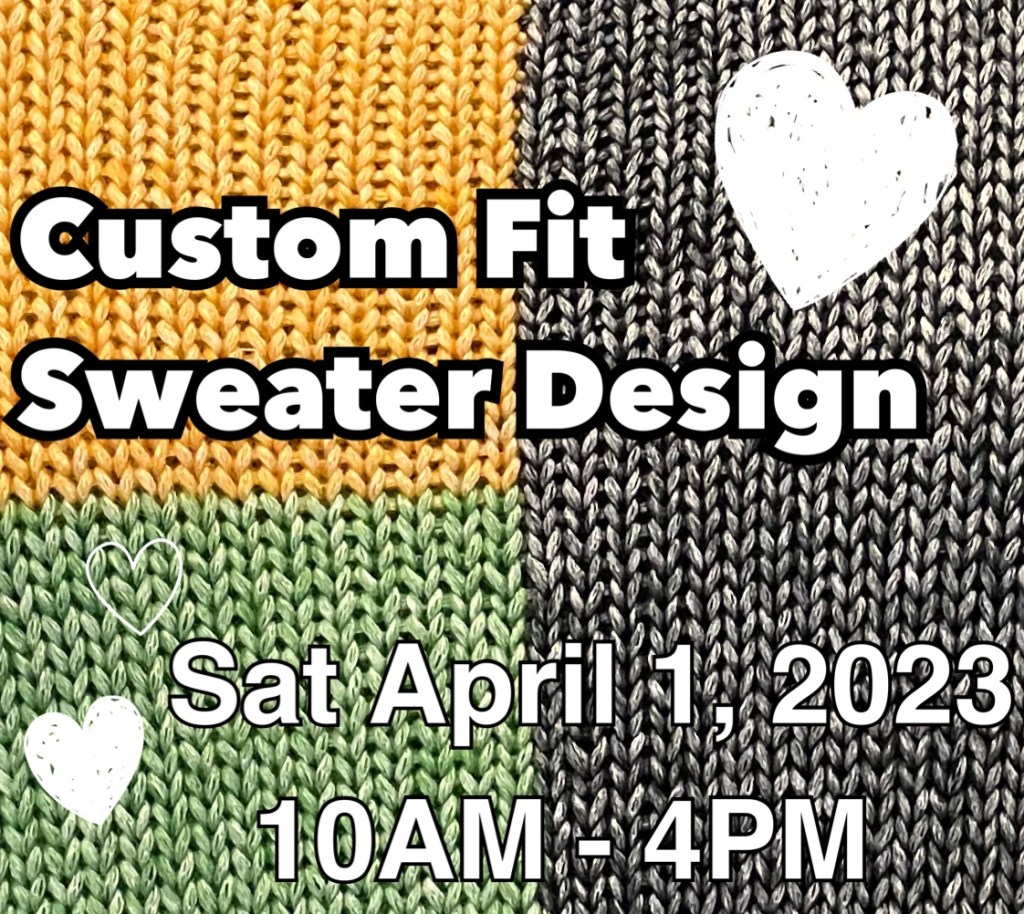
Spring Seminar Coming Soon! April 1, 2023

Thatโ€™s right! Itโ€™s nearly time for our next seminar!

Hand and machine knitters, you wonโ€™t want to miss this!

Weโ€™re learning how to design a custom fit knitted sweater!

Attendees will learn measurement tips and tricks to accommodate various body type needs and draw a body block schematic based off of their own measurements.

Weโ€™ll discuss easeโ€”what it is, what it means for fit, and how you may not actually wear the โ€œsizeโ€ you think you do because of it.

Thatโ€™s not all! Weโ€™ll talk about how material choice affects garment fit and design considerations you should consider when adding elements to your sweater.

Hope to see you there on April 1, 2023 from 10:00AM – 4:00PM at Get Stitchinโ€™ in Tulsa, OK.

Visit Get Stitchinโ€™s website to sign up today!

https://www.getstitchin.com/machine-knitting-seminar

Knitting Machines, resources

Resource Roundup- YouTube Edition

Do you have a favorite machine knitting YouTuber? You will after this post!

Each channel name links to the channel, so check them out!


Anna Haferman

Anna has a tutorial about using a KnitLeader with the LK 150! How awesome is that?

She also has project videos with really clever ways to work fair isle among other things. Iโ€™ve been watching her channel a lot lately, and she might be my favorite machine knitting YouTuber!


Diana Sullivan

Dianaโ€™s channel features beginner lessons along with cast-on, cast-off, and edging videos.

This pinwheel baby blanket was one of my very first machine knitting projects. (Her channel doesn’t allow embedding videos, so there won’t be a preview for this one.)


Creative Tien

Creative Tien features machine knitting, crochet, and sewing tutorials. I found the channel very recently but have really been enjoying it.

I really like the scalloped edges from this video:


Knitology 1×1

Channel owner Elena works in London as a knitted textiles designer and shares stitch and project tutorials.

The braided cable in this tutorial makes a lovely tank top strap that I canโ€™t wait to try:


Claire Newberry

Although she only has a few videos, theyโ€™re worth the watch. Plus, she wears gorgeous sweaters as she films!

I particularly enjoyed her bead knitting video. The swatches she displays at the beginning are gorgeous!


Caroleโ€™s Country Knits at Rocking Horse Farm

I believe they might be more active on Instagram, but the Rocking Horse Farm channel is still worth a visit!

My brain isnโ€™t quite happy with the 90 degree rotation from flatbed to circular sock machine, so this short rowing video has been helpful:


The Answer Lady

You may know the channel from the Ask Jack machine maintenance videos, but channel also includes pattern tutorials, tips, and tricks. Iโ€™ve seen Circular Sock Machine tutorials recently, too!


The Knitting School Online

TKSO offers more classes on their website than their channel, but you can get a good idea about their paid content through their YouTube content.

This double bed jacquard video made me excited to try out my color changer attachment.


Roberta Rose Meads (previously Roberta Rose Kelly)

Some videos may be โ€œoldโ€ by YouTube standards, but the channel is a wealth of knowledge.

Iโ€™m obsessed with short rows, so learning you can do intarsia using short rows was amazing! Check it out:


Susan Guagliumi

In addition to her books, Susan Guagliumi has Craftsy videos! Not all of them are on uploaded to YouTube, but if you’re looking to see if her Craftsy content is worth it, and I’ve had many people tell me it definitely is, check out her channel!


Knit It NOW

Sue at Knit It NOW has a wonderful website with a yearly subscription that she introduces on her channel. You can have a free membership with access to some of her content on her website, but YouTube is still a good way to browse some of what you can find at her main site. (Her channel doesn’t allow embedding videos, so there won’t be a preview for this one.)


While in-person learning will always be my learning preference, I love finding new machine knitting video resources!

Who am I missing? Iโ€™d love to watch your favorite machine knitting YouTubers.

Thanks for tagging along with me on my machine knitting journey!

News

February Happenings

Wow! January flew by! I hope you all are staying warm and well.


Winter Knit-A-Long Continues

Don’t worry if you missed any meetings in January!

If you’d like to join us in knitting the Festival of Stitches by Lisa Hannes, please do! This is a very casual KAL focused on knitting fellowship as we all finally take time to make something for ourselves.

Every Wednesday from 12:00PM to 4:00PM we’ll be at Get Stitchin’ working on this beautiful wrap.

I’ve had a wonderful time making new friends and chatting with old friends. I hope you’ll join us if you’re in the Tulsa area!


Important Date Change–Machine Knitting Spring Seminar

Originally scheduled for April 8, 2023, our Spring Machine Knitting Seminar is now APRIL 1, 2023 from 10AM-4PM.

Someone, not naming names, (EMILY), used Orthodox Easter to schedule the week before Easter. (I learned something, though. That’s good, right?)

Joking aside, I apologize for any inconvenience this scheduling change might cause. I hope that we have changed things early enough for anyone who has already planned their trip to Tulsa to reschedule without issues.

Again, the Spring Machine Knitting Seminar is April 1 from 10:00AM to 4:00PM.

Visit the Event Page on Get Stitchin’s website to sign up.

Pamela Carrico of CMO Designer Knits returns to share over 40 years of machine knitting experience with us.

We will be learning to make a body block and designing a custom fit sweater from that body block!


Eureka! Fiber in the Ozarks

March 16-18, 2023
Eureka Springs Community Center

Find some ELY Knits handmade goodies among others from the Get Stitchin’ crew at the Eureka! Fiber in the Ozarks festival in Eureka Springs, Arkansas.

Visit the festival’s website to learn more.


Sock Club is coming in March!

There’s more fun coming to Get Stitchin’! Sock Club is starting up in March and will run all year through November. Every 2nd and 4th Saturday of the month from 10:30AM-12:00PM I’ll be going over the Sock of the Month.

If you prefer weekdays, Ms. Terry has a weekday meetup every 2nd and 4th Tuesday.

This is not a class, so you will need to have some experience already, but Ms. Terry and I will be around to help you troubleshoot. This will be a great opportunity for newer sock knitters and veterans alike as we explore heels, construction methods, and new sock yarns.


As always, you can check out my Google Calendar for standing classes, events, and shows.


Class booking and availability will be according to Get Stitchin’s website, so be sure to check their Classes page.


If you would like to book a lesson that is sold out or is not on the schedule, please contact me and we will find a date and time that work for you.


Patterns

The Doodle Beanie โ€” Free Machine Knitting Pattern

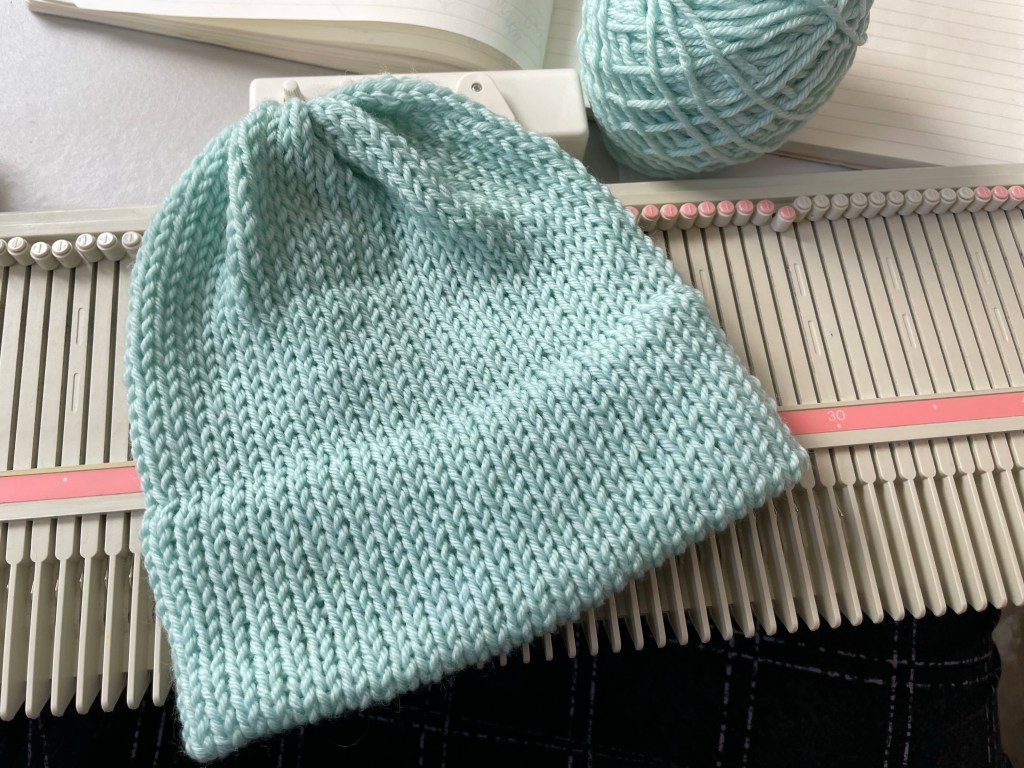
I was playing around on my Silver Reed LK150 a while back and came up with this simple beanie that begs to be customized. This hat has a folded brim and a cinched crown that would look great with an added pompom.

Itโ€™s just a rectangle, but itโ€™s the perfect template to doodle around with and try out new things as you develop your machine knitting arsenal of techniques. I hope you enjoy it and put your own spin on it!


Materials

50-150g of Worsted Weight Yarn (Samples use Cascade 220 Superwash Wool at T7)
Silver Reed LK 150 6.5mm knitting machine

Sizing

Baby- 60 stitches, 30L-30R
Child/Teen- 80 stitches, 40L-40R
Adult- 90 stitches, 45L-45R
Adult L- 100 stitches, 50L-50R

Gauge

4 st per in at T7 in Cascade 220 Superwash


The Doodle Beanie concept will work with any machine gauge and suitable yarn. Knowing your stitches per inch from swatching yarn is immensely beneficial, so I encourage you to swatch beforehand if you have no clue what yarns knit best at what tensions on your machine. 


Pattern Instructions 

Set Tension to 7.
E-wrap CO 60 (80, 90, 100) stitches.

Brim:
Knit 20 (30, 40, 40) rows.
Hang hem by picking up the e-wrap and hanging it on the needle above it. 
Knit 1 row at T9. 

Revert back to T7.
Reset to RC000

Body:
This is the place to experiment with stitch patterns, stripes, etc
Knit 20 (30, 40, 40) rows.

Crown: 
Transfer stitches to EON.

Tension down to T6. Knit 1 row.
T5. Knit 1 row. 
T4. Knit 1 row.
T3. Knit 1 row.


Finishing:
Do not remove stitches from needles. 
Leaving a tail long enough to seam the beanie, cut yarn. 
Thread needle and sew through the live stitches from the opposite side of the tail before removing the beanie from the machine. 
Cinch the top of the beanie together. 
Pull tightly but be careful not to break your yarn. 

Mattress stitch the sides of the beanie together. Weave in ends. Attach a pompom if you like. 


Modification Tips and Ideas

For a rolled brim, halve the number of rows in the brim step and do not hang the stitches.  

If you are not comfortable using your transfer tools or are in need of a very quick knit, tensioning down alone will work, but you will need to cinch the top together above the remaining live stitches like the pictures below to close the crown. The density of stitches at the crown is why we decrease to EON.


If you want a bit of a slouchy beanie, you can add 5 rows and skip tightening tension in the crown altogether. It will be easier to cinch the top if you decrease to EON.

Try knitting two strands of smaller yarns together or using variegated yarn to spice up the simplest version of this hat. 


Abbreviations

COCast On
BOBind Off
WPWorking Position
CORCarriage on Right
COLCarriage on Left
EONEvery Other Needle
RC ###Row Count ###, i.e. Row Count 023
T#Tension and size number (Tension 1, Tension 2…)

What will you doodle?


Did you knit a Doodle Hat? Please consider sharing your projects on ravelry so I can see what you made. I love seeing project pictures!

If youโ€™d like to help support the site, please consider buying me a Ko-Fi.

As always, thank you for joining me on my machine knitting journey! Let me know what you think below in the comments. Iโ€™m also happy to hear from you via my contact form or on Instagram.

resources

Looking for Machine Knitting Media? Pin it!

Sometimes you just want to scroll the internet and see what others are doing with their knitting machines. You might use Facebook groups or your Instagram feed, but what about Pinterest?

I’ve used Pinterest since it began in 2010. I planned my wedding by making mood boards and plotted out interior designs for our first house. Now I use it for nail art inspiration, bullet journaling spreads, hair styling tips, and yes, machine knitting.

Pinterest’s machine knitting recommendations for me

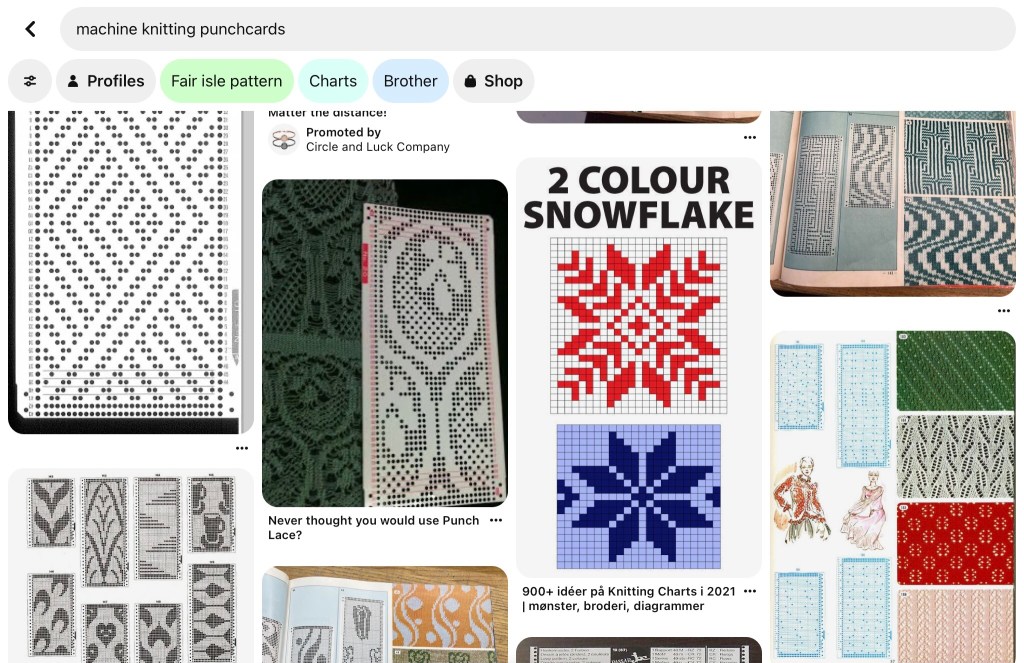
I’ve been making stockings lately, so I searched Pinterest for punchcard patterns.

search results for machine knitting punchcards

Not bad! But I should’ve specified “Christmas punchcards”….

Sometimes Pinterest gets hand knitting, machine knitting, crocheting, and other yarn crafts confused, but that’s okay!

They’re at least knitting charts!

Don’t be upset if your search brings up hand knitting or even cross stitch charts! Remember that you can hand transfer lots of lace patterns and hand select colorwork patterns, so even if a chart wasn’t originally meant for the knitting machine, you can still put it to good use!


You can check out my Machine Knitting board on Pinterest here and follow it if you want.

my machine knitting board

What sites do you use to find machine knitting inspiration or patterns? I’m always on the lookout for new inspiration!

Knitting Machines, News, Seminar

Spring Machine Knitting Seminar

It’s been a while, everyone!

I hope you’ve been doing well!

If you follow me on Instagram (@ely.knits), you’ll know that I recently hosted my first machine knitting seminar in Tulsa at Get Stitchin’!

“Fit, Fabric, and Finishing” was our theme on October 15. Pamela Carrico of CMO Designer Knits showed us ways to tailor knits to be truly custom, well-finished items and reminded us that we make fabric and can make so much more than just sweaters on our machines.*

Things went so well that we decided to schedule the Spring Seminar already!

**Important Date Change!**

Updated February 2023

Join us Saturday, April 1, 2023 from 10AM-4PM for a machine knitting seminar featuring Oklahomaโ€™s own fiber artist Pamela Carrico!

Pamela has over 44 years of experience in fiber arts and creates one-of-a-kind handmade pieces that have traveled the world. 

The spring machine knitting seminar is brought to you and sponsored by ELY Knits. (Me!)

Click the date above or this link to go to Get Stitchin’s website and sign up! We’ll be teasing out more info as we get closer to seminar, so stay tuned!

First sneak peek:

Do you know what a body block is?

*If you missed it and would like to purchase a copy of the patterns we learned, check Pamela’s Etsy store, where PDF downloads will be available for purchase soon.

If you were wondering where in the world I’ve been and why there haven’t been any posts in ages, here’s the personal stuff:

We moved!

Before, I had the smallest bedroom in the house stuffed full of my knitting, but now we’re on an acreage and I HAVE A STUDIO! I’m so excited!!

It’s still a huge mess even though it’s been six plus months since we moved… but things are beginning to shape up.

I have shelving for my vintage magazine and book collection and a wall of pegboard for my cones and hanks. My to-be-cleaned-and-restored machines have their own shelf in a workroom so I can keep any chemicals separate from the yarn.

It still seems unreal to have a studio, but I have one with two rooms now! And running water! (If this place had a bathroom I’d get a mini fridge and a cooking burner and just live here. Sorry husband…)

Eventually I’ll teach private lessons in the studio, but for now, I’m keeping things at Get Stitchin’ in Tulsa.


I’ve had two surgeries since the move, and recovery has taken a while.

One of the surgeries fixed a tendon issue in my thumb and wrist, but I still have numbness in my hand from the nerve being moved to reach the problem. That should continue to fade as time passes. (See this post for some background on my hands.)

While I’m pretty much recovered from my surgeries, I still have some specialists left to see for a more systemic health issue, so it may be a while before I return to my previous schedule. Even though I hate to, I don’t feel like I can 100% commit to regular posts yet.

But I will still do my best!


You can keep up with things I think are interesting but perhaps not blog post worthy on my Instagram @ely.knits.

Thanks for reading, and I’ll see you soon!

Accessories, Knitting Machines

Silver Reed SRP 60N Ribber Attachment Unboxing and Assembly

Last time, we unboxed and assembled the Silver Reed SK 840 standard gauge 4.5mm knitting machine. Now itโ€™s time to learn what comes standard with the Silver Reed SRP60N 4.5mm ribbing attachment, often referred to as a ribber bed or simply a ribber.

Let’s see just how adding a second needle bed expands your machine knitting repertoire!


Compatibility

The Silver Reed SK 840 standard 4.5mm gauge knitting machine is the only current model the SRP60N bed fits. The SRP60N will not knit on its own and must be used with a main bed.

This attachment also fits older, discontinued models SK 210, SK 500, SK 580, SK 700, and SK 740. These could be labeled with Singer, Studio, Knitmaster, or Empisal brands, which were also produced by Silver Reed. This bed works with both punchcard and electronic machines.


Unboxing

Just like the main bed, the SRP60N ribbing attachment is securely packed in a shipping box and another box contains the actual ribber bed unit. The attachment and its accessories weigh in at around 30 pounds.


“helping” with accessories

The accessories come in a long, specially molded styrofoam block that slides in over the needle bed.

The styrofoam holds ribber-specific cast-on combs, a needle pusher, punch cards, a handle, a plating guide, and weights.

Instead of claw weights, the weights are cylindrical with a hook at the top. The smaller weigh about half a pound, and the larger weigh about a pound.

Mind your feet with these weights! It does NOT feel good if one falls on your bare feet!
(Learn from me and wear shoes when you machine knit.)


Be careful with this part of the unit!

The ends of the needle bed are held up with the help of two more molded styrofoam pieces and a flat spacer. These keep the back of the ribber bed safe during shipping and storage.

Each back side of the bed hosts a joiner point where the ribber slides into the main bed. These can be easily bent and damaged if the ribber bed rests on them, so the bed is packed needle-side down.

The ribber is not built into its own carrying case like the main bed and needs to be stored in a way that does not damage the attachment plates on the back, so I strongly recommend keeping the box and foam it came in.

If you uninstall the ribber from the main bed for transport or storage, put it back in the box with its special foam pieces, even if it’s temporary. Otherwise, gently place it needle side down in an out of the way place, or needle side up on a chair and allow the attachment points to hang down without touching anything.


auxiliary pieces to the main bed

Important note: the SRP60N comes with two “auxiliary pieces” that screw into the main bed on each side front that are required to attach to the main bed. The ribber will not fit properly unless you install these, so don’t lose them!


What does adding a ribber let you do?

Ribbed Stitches

As you’ve probably guessed by its name, the SRP60N ribber bed allows you to knit rib stitch patterns without manually reforming the stitches with a latch hook tool. If you knit ribbed edgings often, this attachment will save you a lot of time.

The main bed (the SK 840, sold separately) creates knit stitches while the ribber bed (the SRP60N) creates purls. You can use needles from each bed in combination to create simple rib stitch patterns like 1×1 or 2×2 ribbing, but that’s just the beginning.

Using punch cards or design software like Design A Knit 9, you can create special stitch combinations for endless fabric design opportunities. New combinations include tuck stitch ribbing and fisherman’s rib (think brioche, hand knitters! That’s actually a type of tuck stitch), as well as lace, cables with defining purl stitch patterns, and a special type of colorwork called double bed jacquard.

Circular Knitting

One bed means everything is made flat, but two beds means a tube!

Because the SRP60N has 200 needles just like the main bed, circular knitting with up to 400 stitches is possible simply by adding a ribber.

One round of knitting will take two passes of the carriageโ€”one pass for the main bed and one pass for the ribber bed.

I love being able to knit in the round on my flatbed machines. Socks are my current circular knitted favorite, but youโ€™re not limited to small items like you are with circular sock knitting machines that generally have around 70 stitches. Remember, you have 400 needles now!


Assembly

“Read the manual!” sounds like a cop-out on an unboxing and assembly post, but the manual should always be your first stop, especially if you are installing the ribber on a different model than the SK 840 I’m using.

There are diagrams, instructions, part names, and troubleshooting sections.

If you lose your manual, you can download a PDF copy at Machine Knitting Etc.

Table or Stand

Whatever you use to set up your machine needs to be able to withstand some torque. I prefer using a metal tilt/A-frame stand when I work with two machine beds since I don’t have a sturdy table that fits the clamps.


The first step in installing your ribber is to take down the main bed.

Take the tension unit out and set it aside.

The ribber needs to sit at a specific angle on the table/stand for the beds to knit properly, so taller, angled clamps are included with the attachment.

left: ready to install
right: installed

Remove the main bed’s original clamps and install the clamps that came with the ribber. Make sure the clamp slides to the smaller side of the hole and securely tighten it. Reattach the main bed to your table/stand.

Screw the auxiliary pieces (pictured earlier in the unboxing and seen in use below right) into the main bed and then insert the ribber attachment points into the slot of the auxiliary pieces. Secure the ribber to the table/stand with the main bed’s clamps.

left: angled clamp securing main bed
right: original main bed clamp securing ribber bed

Stand users: Your stand may have come with a part that sits around and under the tall clamps (as seen above on the left). This piece did not come with the ribber. I personally haven’t noticed a difference in stability between using it and leaving it out, so don’t worry too much if your stand doesn’t have one.


In addition to four clamps, the needle beds are further stabilized with ribber join supports. You simply flip the pieces up so they touch the main bed.


top: aligned
bottom: offset

The centers of the main bed and ribber bed are each marked with a zero. The alignment of the beds is adjustable depending on which type of knitting you want to do, but when you’re setting things up, you generally want the zeroes to align and then adjust from there according to the manual.

The ribber can be lowered so you can knit using only the main bed without uninstalling the ribber, but it must be fully raised to perform its functions.


The ribber has its own carriage that slides across the needle bed and has a special attachment for the main carriage called the ribber arm. You must use the ribber arm in the main carriage for ribber functions.

To install the ribber arm, remove the main carriage sinker plate by unscrewing the knobs and sliding it out. Put it away in the main bed’s lid. Slide the ribber arm in place where the sinker plate was, and tighten the knobs.

Do not over-tighten. You could strip the knobs. Hand tight is enough to securely hold the ribber plate.

The ribber carriage slides on to the tube-like railing at the bottom of the ribber needle bed. It leans toward you when you install it, but it must be flush with the ribber bed to use. Simply push it toward the needle bed to achieve this.

The main carriage and ribber carriage work in tandem and must be attached to properly function. The ribber carriage will click into place under the main carriage as you slide it along the bed. The two carriages can now move as a unit to knit.

The final step is replacing the tension unit. The tension rod has a bend at the bottom that bends away for use with the main bed alone but needs to bend towards you when the ribber is attached. This puts the rest of the tension unit pieces backwards, so you need to flip them around on the rod.

And there you have it! The Silver Reed SK 840 with the SRP 60N attachment, all set up and waiting for yarn!


If youโ€™re interested in purchasing current Silver Reed knitting machines or accessories, please contact me. I sell Silver Reed knitting machines through Get Stitchinโ€™ in Tulsa, Oklahoma. Weโ€™re happy to custom order current Silver Reed machines and parts for you, and we keep the Silver Reed LK 150 plastic hobby machine in stock. Please be aware that we are experiencing some delays in delivery due to supply chain issues like everyone else, but we will keep you informed each step of the way.

And stay tuned! More accessory unboxings and demos are coming to help you learn what each machine can do and what add-ons you might want or need for your favorite stitches.


Thanks for reading! I hope you enjoyed this look at everything that comes standard with the Silver Reed SRP60N ribbing attachment that fits the SK 840 standard gauge metal bed knitting machine.

Did I miss anything? What would you like to see next? Let me know in the comments below!