Tips and Tricks

Twelve Tips for Stitching When Your Hands Hurt

I have a genetic connective tissue disorder. Itโ€™s not going to get better. It will probably get worse. Iโ€™m not going to stop what brings me joy, but I do have to listen to my bodyโ€™s pain and adapt.ย 

Machine knitting allows me to do a lot on bad days, but I still love hand knitting and crocheting. When I canโ€™t muster the strength to push a carriage or walk to my studio, I can usually hold a project to stitch on the couch.


Iโ€™m not a doctor. This is what has worked for me and might work for you.
Talk to your doctor about your situation and symptoms.ย 


Talk to your doctor. Be clear about what you want from them.

โ€œThis hand pain has negatively impacted my life and daily activities. I need recommendations for strengthening exercises and pain management that are not just medication.โ€ย 

Please advocate for yourself and your needs. It can be difficult if youโ€™re not used to speaking that way, but a doctor has limited time with you during an appointment, so you need to be clear and direct. 


1) Slow Down

Literally. Slow the tempo of your stitching. Sometimes slowing down alone will lessen the pain.
Try to notice when in the stitch forming process hurts or feels awkward. Use that knowledge to start modifying how you stitch.

2) Change How You Stitch

Try another method of holding your tools or yarn.
Try another way to form the stitch- switch from continental knitting (picking) to English style (throwing).
Change your crochet hook hold from the knife hold to the pencil hold.

I hold my right hand completely still since my right wrist, thumb, and first finger are my most painful joints when stitching. My left hand does all of the yarn tensioning, yarn throwing, and any movement of the needles or hook.

3) Wear Compression Gloves

Try to find a soft, non scratchy material. Pressure can help reduce swelling and pain. The glove itself will help retain warmth, which can help painful joints.

4) Wear a Brace or Tape

Consult your doctor or physical therapist for properly fitted brace and kinesio tape placement, but you might need more than just compression gloves.

5) Take Breaks

Set a timer or a specific number of rows and make yourself rest after each interval.

6) Heat or Ice Packs

Use whichever makes you feel better or both. You can find reusable packs online that can be both microwaved for heat and frozen for icy needs.

7) Prop Up with Pillows

Use your couch throw pillows or buy a specialized pillow (I’ve seen breastfeeding pillows suggested) to prop up your elbows or whatever body parts get fatigued the most when you stitch.

8) Use Pain Patches or Medicine

If your doctor okays them, use over-the-counter pain patches like Icy Hot or Salonpas along with NSAIDS or acetaminophen when your pain requires it. You don’t have to suffer through pain without medication when you need it. If it’s bad enough, ask your doctor about pain medication.

9) Work on Small or Lightweight Projects

I’ve noticed heavier yarn weights weigh more! (No waaaay!) More weight leads to more fatigue, so choose lightweight or small projects on rough days.
Bulkier yarns mean larger motions for stitching, and those can cause fatigue faster than smaller movements.

10) Check Your Posture

Are you craning your neck or hunching your back? Try to achieve good posture so hurt and fatigue don’t enter your body from other places while you focus on your hands.

11) Stop to Stretch

Ask your doctor or physical therapist for stretches and strengthening exercises to help your hands.
YouTube has a lot of hand yoga videos that can help if your insurance doesn’t pay for physical therapy.

12) Come Back Tomorrow

It’s okay to stop and admit stitching just isn’t going to happen today.

It’s okay to be disappointed you can’t stitch today.

Tell your project “see you soon, raccoon” and come back tomorrow.


Be nice to yourself. Sometimes your body just canโ€™t. 

Tips and Tricks

Choosing Colors

In my last post I showcased a project where I used NINE colors to push my creative boundaries. I ended that post feeling more confident, but when I went to choose colors for my next colorwork project, I found myself even more color-shy than before!

Since I’m still not convinced I know enough about colors to be allowed to choose combinations on my own, I thought I’d share different ways to choose a color palette that will help you build and discover your own color stories.


Use a Color Wheel

To me, using a color wheel feels like the “pro” way to choose colors. It’s the way “real” artists do it, or so my head says.

(I’ve considered myself a “real” artist for a while now, and I only just bought a color wheel, so let’s all remember to ignore those negative “not a ‘real’ artist” thoughts if they pop up, okay?)

If you don’t have a color wheel and/or a local place to buy one, please consider using my Amazon Affiliate link to support my site! I may receive a small commission at no cost to you, and it helps me keep my content free.

This post from Felt Magnet explains how to use color wheel and defines the associated terms. There are lots of other great posts on Color Theory and color wheels out there, so search up a few and give them a read if this one wasn’t enough for you.

I bought my color wheel from the Across Generations natural dye booth at the Fiber Christmas in July fiber festival. She doesn’t seem to have any in her Etsy shop, but her colors are so amazing and inspiring that I wanted to make sure I linked her because you can …


Use Your Favorite Artist’s Colors

You like them for a reason, right? If you aren’t confident enough to trust your gut, trust someone else’s!

Since most artists now have websites and/or social media, you can keep up with their work without going to galleries.

Find a piece that speaks to you and identify your favorite colors from that piece.

From my slightly overwhelming experience with nine colors, I suggest you start with just two or three.

Kacy Latham is my favorite artist, hands down. I love the way she plays with bright colors and texture as well as the way her shapes flow. We actually grew up in the same town, and while I don’t know her well because she’s a bit older than me, I’ve followed her art journey for years now. She is constantly pushing herself to create and share her work, even painting numerous public art pieces for the residents of that tiny town in Texas to enjoy.

What colors would you choose from this piece from Kacy’s Instagram?

I chose the darkest navy blue from the top right and the rosy, bronze-y brown just left of middle.


Follow Indie Dyer Collections

Don’t forget your favorite fiber artists!

If you keep up with your favorite dyers on social media, look through their feed or ask them how they choose their colors when you visit their booths at fiber festivals. Jenny at 316 Dye Studio recently released an entire collection inspired by Bob Ross paintings!

Sometimes indie dyers will even feature curated palettes of their yarns, so it’s worth it to go see what they’re up to when you’re looking for color inspiration.


Go Through Your Finished Objects

Even if you’ve knitted it up already, take a look at your favorite yarns and completed projects and try pulling your color palette from them, especially if you used a kit or a yarn with an existing color palette.

I don’t even know where this scarf is right now…

I hand knitted this Gallatin Scarf back in 2016. I hated the yarn but loved the colors. The self-striping element made knitting through the pattern interesting, and I can see this palette being perfect for a floral colorwork sweater.


Use an App

As mentioned in my Confronting Color post, you can browse a color palette app like Coolers.co for inspiration. You can also create your own palettes with up to five colors without a Pro subscription.

My favorite feature might be pulling a five color palette from an existing image.

You simply drag the white circle selector to different colors to change what it generates in your palette.

Canva.com also has a similar image palette generator. I’ve only used the free versions, but both Coolers and Canva have additional features in their subscription only tiers.


Browse Pinterest

It’s one of my favorite time wasters that I can justify as not actually being a time waster because I find can find punchcard patterns and more on it

As ad-filled and misdirected as its links can be, Pinterest is still perfect for making mood and inspiration boards.


Ask Around

In addition to having fiber suggestions, your local yarn shop is a great place to ask about color combinations. Since the owners have likely already ordered for the coming season, they might be able to point you in the direction of future color trends.

Your LYS’s staff probably aren’t the only helpful people around in your fiber community. In my experience, there’s always at least one regular who everyone counts on for their color choosing capabilities.

Get Stitchin’, where I teach lessons, in Tulsa, OK almost always has a trunk show rotating through the shop. She also carries yarns and fiber from local specialists, so if you don’t have a favorite indie dyer or fiber farm, you will soon!

You probably have a local shop closer to you than you think. Ravelry has a Local Yarn Shop Directory, and most yarn brands have a stockist locator on their website. If you don’t have a local shop to frequent, I hope you find one soon!

How do you choose colors for your projects? What other ways should I try to find color inspiration? Let me know in the comments!

Thank you for joining me on this colorful leg of my machine knitting journey!

Tips and Tricks

Organizing My Studio: The Main Room


This post contains affiliate links. If you purchase something using one of my links, I may receive a small commission at no cost to you. If you don’t have a local place to support, please consider using my link as it helps me continue to provide you with quality free content.


We moved to our new place last year, and I have a studio! Yay! It’s a small building around 400 square feet just steps from our garage.

Itโ€™s been a dream come true having a large, dedicated machine knitting space and not just a small craft room, but itโ€™s a lot more chaotic than I hoped.ย 

I rushed to move my things in and managed to paint the paneled outer workroom wall before I had a couple surgeries. I’m not fully unpacked yet.


Wall Storage

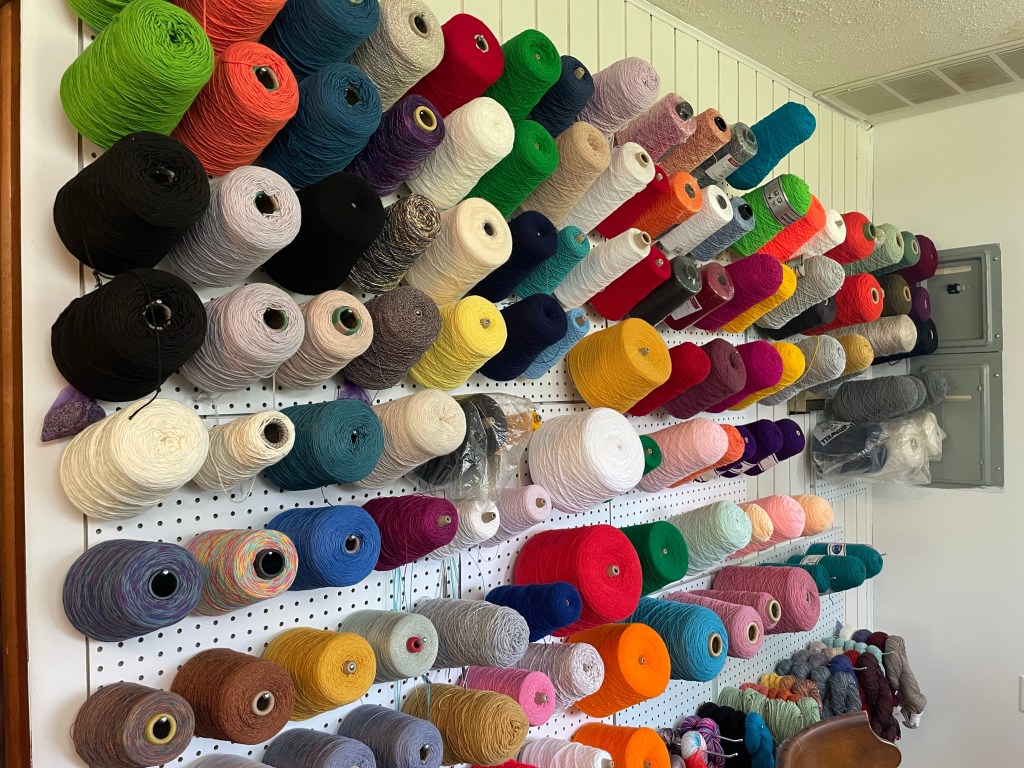
I painted the paneled outer workroom wall and covered it with 2×4′ pegboard panels.

All of my cone yarn was finally on the wall… until I found some new old stock yarn and brought in nearly a hundred more cones. (Find some tips on how to find cone yarn in this post.) I had to move my hanks to make room for the extra cones, so I needed more pegboard and more hooks.

I ended up using 16×16″ metal pegboard squares for the rest of the pegboard wall so I could work around my thermostat.

working around the thermostat

If I had to go back, I think I’d opt for using the 16×16″ size for the whole pegboard wall since I had to wait until my husband had time to help me with the large pegboard and I could install the smaller squares myself.


Here’s what I used:

Triton 2 x 4′ Pegboard 4 Count6″ Pegboard Hooks (better for cones)
Metal 16×16″ Heavy Duty Pegboard – 4 Pack
8″ Pegboard Hooks (better for hanks)

Cube Storage

wooden cube storage in my old setup-so cute but so cramped!

My wooden cube storage is full of my knitting books, my vintage magazine collection, and my personal yarn, so, you guessed it, I needed some more storage after finding more vintage patterns.

I opted for a wire mesh cube set that I could reconfigure as needed since I have been rearranging machines and yarn every few months to test layouts. It currently sits under a window, so it was nice to be able to work around the frame.

hanks waiting on me to order more pegs…

I had to quickly drag the wire cube stack out of the way after an HVAC condensation issue, and surprisingly it stayed together! I didn’t expect that. I wouldn’t suggest moving it like that under normal circumstances, but I wanted to make sure nothing dripped on my yarn.

I think I bought my oldest wooden cube storage unit at Target, but they only come in the 6 cube option there. This one has options from 3-12 cubes, even though I chose to stick with 6 cube units. I have four of them lining a wall now.


What I used

Wood Cube StorageWire Cube Storage

More Work to Do

The studio building was built in the late 1970s or early 1980s, but it is very well insulated. The HVAC has a couple of issues that we discovered after a severe storm-related, days long power outage, some windows need replaced, and some of the lighting fixtures have gone out with no replacement bulbs to be found. I’m using my seed-starting lights as a temporary fix so I can see to knit.

The floor is bare concrete in the main room for one glued down piece of red carpet, and the workroom is tile on top of concrete. I’d like to put in padded flooring eventually.

Oh, and I still have to finish unpacking and organizing my books….


I don’t feel great about how things look in my studio right now, and I really miss my small craft room at our old house sometimes. It had such a cute aesthetic and I really felt creative in that space.

I have to remind myself that I curated the old craft room over the course of the years we spent in that house.

One year I did the walls. Another year I added more storage. The pegboard closet wall came close to the end.

I did all of the organizing in this post gradually over the year or so we’ve been in this house. That’s not bad progress for a busy year at all!

I’ll continue tweaking and optimizing as my budget and time allow. Slow progress is better than no progress!

I hope sharing the slow progress on my studio gave you some inspiration or encouraged you in your own organization progress. If you choose to try out some of the products that I linked, thank you, and please let me known what you think!

I’d love to see pictures of how you utilize your space.

Thanks for reading and joining me on my machine knitting journey!

Tips and Tricks

Finding Cone Yarn

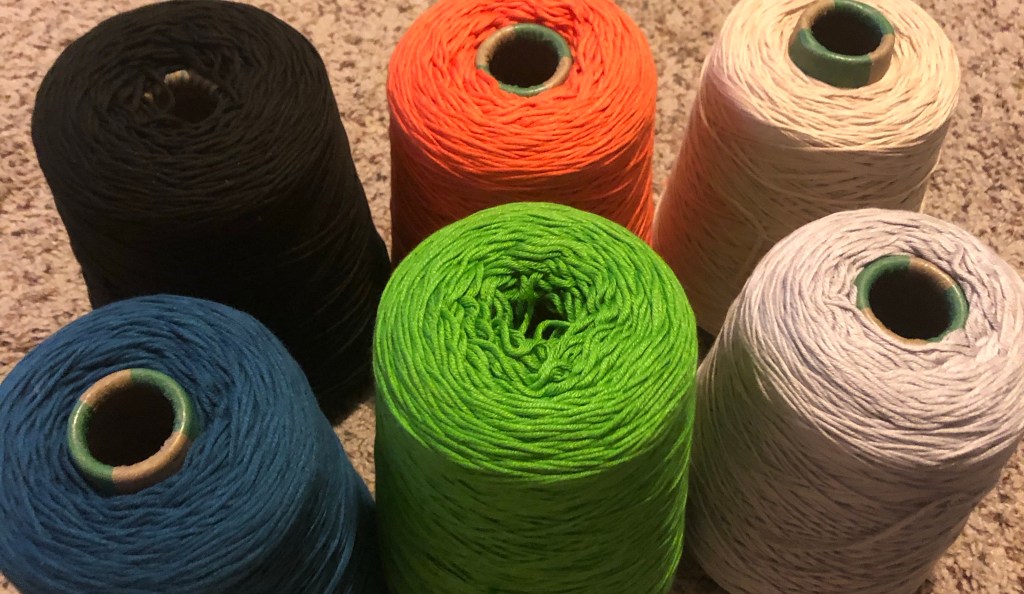
Knitting machines can use a range of yarn from all kinds of put-ups like we saw in my last post, but the easiest and best put-up for machine knitting is cone yarn. Cones donโ€™t need extra preparation before use, have more yardage in general, and often feature unique textures or colors that you might not find in hand knitting yarns.

If cone yarn is so great, why is it harder to find?ย 

In the USA, machine knitting isnโ€™t as common as it once was. While the hobby is growing again, itโ€™s kind of seen as a niche within a much more popular one or even as โ€œcheatingโ€ at hand knitting. Yarns made and wound on cones specifically for machine knitting arenโ€™t really a thing here anymore.ย 

On the retail side, cones are larger and more difficult to display compared to other put-ups. Most shops donโ€™t have the shelf space to dedicate to a few 1-2lb cones that would otherwise be filled with 10-15 skeins or hanks. Many hand knitting or crochet projects donโ€™t need the thousands of yards that can come on a cone. Additionally, shipping cones generally costs more for the number of products you get than other, smaller put-ups.ย 

The downsides of retail shouldnโ€™t keep you from using cone yarn in your machine knitting.

Let me butter you up a bit, reader. If you’re a machine knitter, you already work harder to find your materials, parts, and resources than other yarncrafters have to because of that niche! A little work to find cone yarn is nothing to you, right?


Finding Cones Locally

Iโ€™m a big believer in shopping at local small businesses whenever possible.

So please, 

Check Your Local Yarn Shop

Maybe they have cone yarn and you missed it! Itโ€™s easy to get distracted among the beautiful colors and textures in a yarn haven. Trust me, I understand.ย 

If your local yarn shop doesnโ€™t stock cone yarn, ask them about it!

Most shops are happy to accept special orders.
**Please keep in mind that many distributors have a minimum dollar amount to place an order for new accounts, so it may take your LYS time to reach that amount depending on their size.ย Pay up front and work with your local shop so you both benefit! Convert your yarn friends so more of you need cones! (No downsides to that one, right?)

Get Stitchinโ€™, the shop where I teach lessons, recently became an Ashford dealer. Now they have 0.5lb Ashford cotton yarn cones alongside their Ashford spinning wheels and looms! Those gorgeous yarns work wonderfully on 4.5mm standard knitting machines.ย The owner is happy to order other yarns in, too. I just have to ask!

Oh, speaking of looms,

Ask the Weavers!

Ask your weaving friends or your region’s weaving guild where they source their coned yarns. Many of them will use hand yarns, but those who work with finer yarns will often use cones. (If you donโ€™t have any weaving friends yet, try to make some! Weavers are fun!)

Chat with the Regulars

I live in rural Oklahoma. Most people probably think of Native Americans and buffalo when they think of the state. They definitely don’t think of yarn.

That doesnโ€™t mean hand or machine knitting doesnโ€™t exist here, it just means I had to look a little harder than someone in a big coastal city or European town might’ve had to.ย 

As some of you know, I used to work at a yarn shop in the suburbs that focused on hand knitting and crochet. When my hands started to deteriorate (I talked about it in this post), I had to start looking for other yarn craft options.

I saw Addi circular machines online, but I had never heard of a flat bed knitting machine. I mentioned my machine research once at the old yarn shop with the other regulars, and wouldn’t you know, one told me about the Fiber Christmas In July festival, a wonderful local fiber festival, and a vendor there who specializes in machine knitting!

Who knows how long it wouldโ€™ve taken me to figure things out if I hadnโ€™t stuck around and chatted with the yarn shop regulars?!

My teacher and mentor Pamela Carrico is the fiber artist specializing in machine knitting that customer told me about. Her shop has both hand knitting yarns and machine knitting cone yarns! She has new old stock vintage yarns as well as quality acrylic 2/24 yarns that she sells by the pound, which is really helpful if you want to do a colorwork project but you donโ€™t want to pay for pounds of yarn colors you may only use once.ย 

Asking around helped me find an instructor and materials in one place!


Things worked out wonderfully for me, but what if you don’t have a local yarn shop or yarn community? Making your own is always an option, as is joining an online one.

If you donโ€™t have a local yarn shop, please consider finding a small business online and supporting it before you turn to a big box store. Youโ€™re more likely to find someone who can really help you find what you need at a small specialty shop, too!

Call (Yes, Call) Other Yarn Shops 

I have the Millenial Aversion to Phone Calls. If youโ€™re not a close friend or family, I much prefer text or email, so I understand there can be some discomfort in this tip.

But remember, many machine knitting shops have been in business for decades, meaning they have operated without texts and emails for a long time, so a phone call is going to be your best option, especially as they take care of things in store. Donโ€™t forget to leave a message if you need to. Save the shopโ€™s contact information so you know they arenโ€™t spam when they call you back. (Yes, youโ€™ll have to answer the phone, too!)ย 

At the bottom of this post, you’ll find a list of shops that I know stock machine knitting cone yarn in the USA. If you know of more, let me know in the comments!

Some of these shops don’t have cone yarn listed on their websites but can tell you what they have when you call and ask. Many have “dead stock,” or discontinued cone yarns that are still perfect for knitting. They just aren’t made anymore.


Online Marketplace Listings

If you weren’t able to find anything with info from your LYS or yarn friends, try using Google, Craigslist, and Facebook searches for โ€œ<your location> cone yarnโ€ or โ€œ<your location> machine knitting.โ€ Donโ€™t forget to check Facebook Groups that may meet locally or regionally, either!ย 

Cone yarn is often listed in large lots from estate or garage sales. Since it takes up so much room, many people are happy to meet you somewhere and give you the yarn for an extremely low price or even free.ย I’ve found yarn like this several times. It’s worth checking regularly.

Set a search alert using machine knitting and cone yarn terms so youโ€™ll know when something near you pops up. When you pick up your yarn, ask the seller about their source or where they learned about machine knitting and cone yarn. 


If your local search doesn’t pan out, try some of these smaller businesses online:

Cone Yarn Stockists

Carrico’s Creative Cornerhttps://www.cmodesignerknits.com/Cone Yarn by the Lb, old stock, and more!
Knitcrafthttps://knitcraft.com/SilverReed Importer
The Knit Knack Shophttps://knitknackshop.com/ Tamm Yarns
Peter Patchis Yarnshttp://peterpatchisyarns.com/Email list of Specials
The Yarn Depothttps://yarndepot.orderpromos.com/LARGE cones
Rocking Horse Farmhttps://www.rockinghorsefarmknitshop.com/Machine Knitting Camp
Get Stitchin’https://getstitchin.com/ Ashford Dealer
Ashford Yarnshttps://www.ashford.co.nz/Find local dealer!
WEBS Yarn Storehttps://www.yarn.com/Valley Cone Yarns
YARN ITALYhttps://www.etsy.com/shop/YARNITALYGreat Variety
Silk City Fibershttps://www.silkcityfibers.com/“Wholesale” price
Paradise Fibershttps://paradisefibers.com/collections/coned-yarnFree Shipping after $150 Lower 48
The Wooleryhttps://woolery.com/Weaving Yarns

Have you tried machine knitting with cone yarn yet? Were you able to source it locally? What are you planning to make? Let me know below in the comments!

Disclosures:

I teach hand and machine knitting classes at Get Stitchinโ€™ in Tulsa, OK. Iโ€™m not paid to promote the shop, but things that benefit the shop often benefit me as peopleย may purchase my work from the shop or sign up for one of my classes!ย 

Carricoโ€™s Creative Corner is my mentorโ€™s shop. I’m not paid to promote her shop, but I happily mention it to support her and her work. ย 

Shops listed are provided for informational and educational purposes and are not affiliated with me.

Thanks for joining me on my machine knitting journey! I hope you learned something useful today. 

logo created by the lovely Mimolette Monster

Tips and Tricks

Your YARN is the Problem โ€” Part One: Hand Knitting Yarn Prep

You might have encountered one of these problems before: the yarn stopped flowing through the tension unit and the tension wire bent all the way towards the carriage and needle bed, the carriage jammed, an entire row knitted at a much tighter tension than you wanted, the yarn broke. 

If you are experiencing problems when you machine knit with hand knitting yarn, your yarn preparation (or lack of) might be the problem. Here are some things to consider about different yarn put-ups and the ways they can affect your tension while knitting. 


Hank
Must be wound into ball or cake before use

Donut
I absolutely hate the donut put-up, so I’m going to rant about it!

It does nothing other than look pretty on a shelf. Hand knitting will cause it to fall apart. Putting it in your bag after purchase will cause it to fall apart. Looking at the outer layer cross-eyed will start it on its slinking, unwinding, collapsing journey!

Unstable put-up
Uneven tension
Needs to be contained
Flops around

Yarn Ball
Can roll away
Needs to be contained in a basket or bucket
Yarn can get caught under the weight of large balls causing uneven tension

Skein
Center pull often results in “yarn barf” and/or collapsing skein
Needs to be contained
Outside pull means flopping/traveling/rolling skein and uneven tension as yarn enters machine
Outside pull means stopping after a row to pull out enough yarn to knit a row every time to avoid flopping

Cake
Manual-recommended put-up for Silver Reed LK150
Flat top and bottom
Should not roll
Most even tension of all put-ups mentioned so far
Require ball winder and swift

Cone
Best put-up for machine knitting
Even tension
Large yardage
Not a commonly used put-up for hand knitting yarn


You aren’t an awful knitter if you don’t knit from yarn cakes or cones! But they are the best put-ups that are least likely to cause issues.

I’ve knitted center pull from a skein before. Everything turned out fine, but I did have to stop and fix a few tension issues as I knitted.

I knit from yarn balls all the time, especially for scrap yarn. Sometimes they jump out of their container when I’m knitting quickly and I have to chase them down. It happens.

Knitting from less than ideal put-ups just means I accept I might encounter problems and have to fix them.


A Note on Yarn Cakes

Ideally, yarn winders should wrap around the sides of the cake and not on top or bottom.

If your yarn winder wraps the yarn around the sides and over the top and bottom, the cake will flop and turn like a yarn ball and add additional tension as it does. This is not an ideal cake for machine knitting, but you can make it work by pulling yarn out periodically so it doesn’t have to flop and roll.

Flopping that happens to an “ideal” cake that isn’t wound over the top/bottom likely means there is not enough lead length of yarn from the cake to the tension unit to the carriage (such as the yarn sitting on the table instead of the floor behind the machine), so be sure to give your yarn ample space as it feeds into the tension unit.


Finding Cone Yarn

There are many places to find cone yarns online, but PLEASE visit your Local Yarn Shop first!

If they donโ€™t have any cones, just ask. Most shops are more than happy to custom order yarns. (Just remember some distributors have minimum orders and it might take a bit to meet that number!) And if you don’t have a yarn ball winder and swift, most LYS will wind the yarn you purchase there into cakes for you.

My Local Yarn Shop, Get Stitchinโ€™ in Tulsa, OK just became an Ashford dealer! I donโ€™t weave or spin much, but do you know what comes on cones? Weaving yarn!

(Disclosure: I teach classes, sell Silver Reed knitting machines, and sell my work at Get Stitchinโ€™, but Iโ€™m not paid to promote it. I mention it because I both sell and shop there.)

Carricoโ€™s Creative Corner in Bartlesville, OK, my mentor Pamela Carricoโ€™s shop, has a wonderful array of cone yarns as well as hand knitting yarns. Pamela sells cone yarn by the pound, which is a great option for knitters who donโ€™t want to commit to an entire cone and thousands of yards of one color. She also often has new old stock of discontinued yarns that were made especially for machine knitting.


In the end, the amount of preparation you do when machine knitting with hand knitting yarn is about what youโ€™re willing to put up with. You may be willing to deal with a ball rolling around or unwinding from the outside of a skein before knitting every row, but if you find yourself constantly encountering tension issues and uneven knitting, look to your yarn put-up and preparation first.

Thanks for coming along on my machine knitting journey! How do you prep your yarn? Are you strict about it, or do you knit from whatever you feel like using at the time? Let me know in the comments!