I have a genetic connective tissue disorder. It’s not going to get better. It will probably get worse. I’m not going to stop what brings me joy, but I do have to listen to my body’s pain and adapt.
Machine knitting allows me to do a lot on bad days, but I still love hand knitting and crocheting. When I can’t muster the strength to push a carriage or walk to my studio, I can usually hold a project to stitch on the couch.
I’m not a doctor. This is what has worked for me and might work for you. Talk to your doctor about your situation and symptoms.
Talk to your doctor. Be clear about what you want from them.
“This hand pain has negatively impacted my life and daily activities. I need recommendations for strengthening exercises and pain management that are not just medication.”
Please advocate for yourself and your needs. It can be difficult if you’re not used to speaking that way, but a doctor has limited time with you during an appointment, so you need to be clear and direct.
1) Slow Down
Literally. Slow the tempo of your stitching. Sometimes slowing down alone will lessen the pain. Try to notice when in the stitch forming process hurts or feels awkward. Use that knowledge to start modifying how you stitch.
2) Change How You Stitch
Try another method of holding your tools or yarn. Try another way to form the stitch- switch from continental knitting (picking) to English style (throwing). Change your crochet hook hold from the knife hold to the pencil hold.
I hold my right hand completely still since my right wrist, thumb, and first finger are my most painful joints when stitching. My left hand does all of the yarn tensioning, yarn throwing, and any movement of the needles or hook.
3) Wear Compression Gloves
Try to find a soft, non scratchy material. Pressure can help reduce swelling and pain. The glove itself will help retain warmth, which can help painful joints.
4) Wear a Brace or Tape
Consult your doctor or physical therapist for properly fitted brace and kinesio tape placement, but you might need more than just compression gloves.
5) Take Breaks
Set a timer or a specific number of rows and make yourself rest after each interval.
6) Heat or Ice Packs
Use whichever makes you feel better or both. You can find reusable packs online that can be both microwaved for heat and frozen for icy needs.
7) Prop Up with Pillows
Use your couch throw pillows or buy a specialized pillow (I’ve seen breastfeeding pillows suggested) to prop up your elbows or whatever body parts get fatigued the most when you stitch.
8) Use Pain Patches or Medicine
If your doctor okays them, use over-the-counter pain patches like Icy Hot or Salonpas along with NSAIDS or acetaminophen when your pain requires it. You don’t have to suffer through pain without medication when you need it. If it’s bad enough, ask your doctor about pain medication.
9) Work on Small or Lightweight Projects
I’ve noticed heavier yarn weights weigh more! (No waaaay!) More weight leads to more fatigue, so choose lightweight or small projects on rough days. Bulkier yarns mean larger motions for stitching, and those can cause fatigue faster than smaller movements.
10) Check Your Posture
Are you craning your neck or hunching your back? Try to achieve good posture so hurt and fatigue don’t enter your body from other places while you focus on your hands.
11) Stop to Stretch
Ask your doctor or physical therapist for stretches and strengthening exercises to help your hands. YouTube has a lot of hand yoga videos that can help if your insurance doesn’t pay for physical therapy.
12) Come Back Tomorrow
It’s okay to stop and admit stitching just isn’t going to happen today.
It’s okay to be disappointed you can’t stitch today.
Tell your project “see you soon, raccoon” and come back tomorrow.
Be nice to yourself. Sometimes your body just can’t.
The 2024 Oklahoma Yarn Crawl recently wrapped, and my gosh was it FUN! If you haven’t checked out Part One of my recap, read it first here.
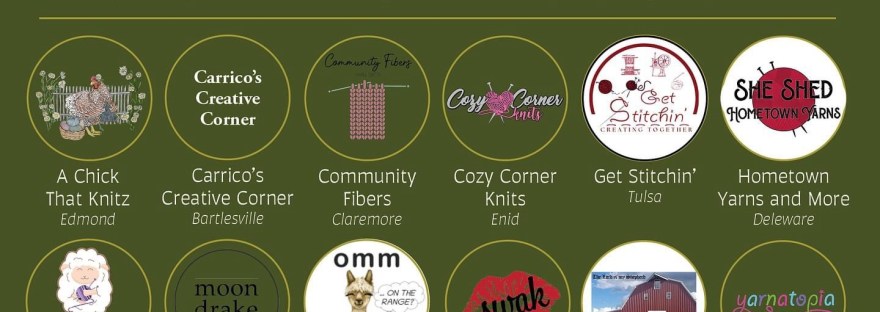
Twelve fiber businesses from across Oklahoma got together to put on the state’s first yarn crawl. Yarn shops, dye works, a working farm, and a mini fiber mill dot the state map, and fiber lovers made the trek to each one during the August 16th to 24th (excluding Sunday) special event.
Each shop had their own special charm and yarns in addition to special events just for the yarn crawl. Some fiber businesses aren’t usually open to the public every day of the week, but they all kept special hours for the crawl.
My friend Susan and I had five of our twelve yarn crawl stops stamped, and set off early in the morning to visit our first shop of the day.
We learned our lesson trying to hit five stores in one day, so we broke up the remaining seven yarn crawl locations into two days— Thursday and Friday,August 22 & 23, 2024.
Each shop we visited was wonderful, and I hope I can convey something special about each one, as they all have their own unique charms and strengths. Oklahoma has a widespread and vibrant fiber community, and the yarn crawl really showcased that.
It was a two and a half hour drive to our first shop of the day, the westernmost in the crawl
Cozy Corner Knits – Enid
I’m fairly familiar with the western part of the state because I have family there. It’s full of farms, oil wells, and wind turbines, but that’s about it. I used to think there wasn’t much else worth visiting in that part of the state.
Cozy Corner Knits is such a welcome addition to that part of the state.
The shop is easy to find if you ignore Google and trust your eyes and common sense while driving. Maps had us take an odd detour through a really cute neighborhood before telling us to turn the opposite direction from the shop we could see right there just across the street.
That wasn’t the shop’s fault at all, so consider calling ahead for directions to any shop if your map app has your route doing silly things.
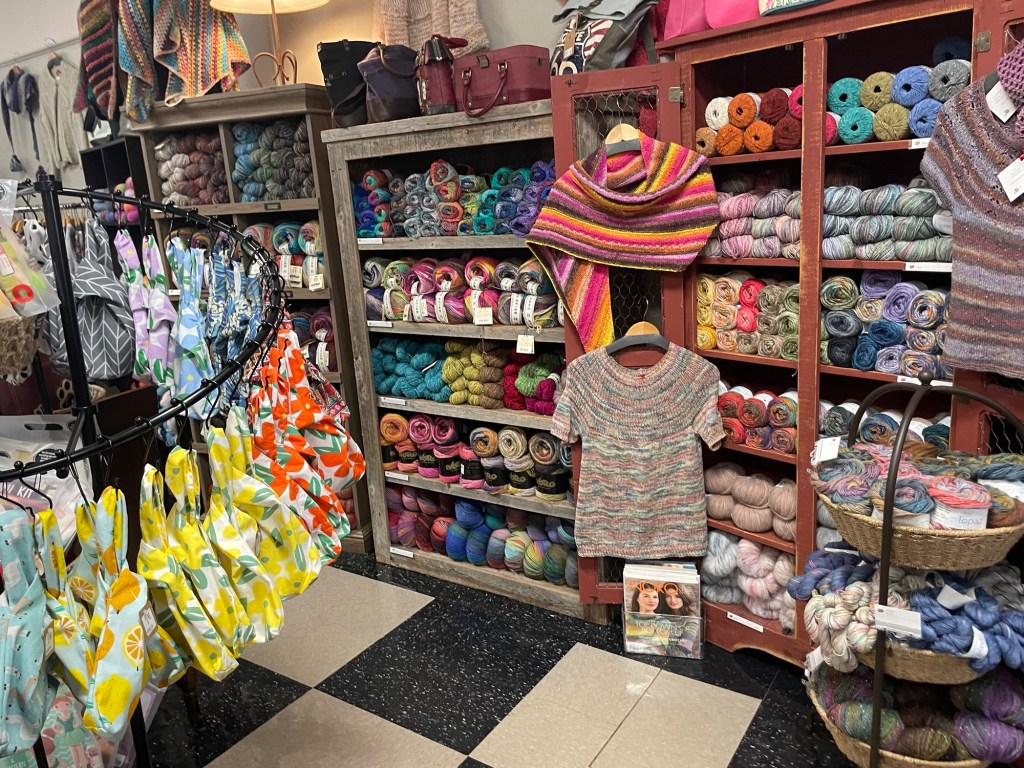
Cozy Corner Knits is very neatly laid out with a knitting area near the front window and nice displays guiding you back to the classroom area at the rear of the shop.
Susan and I had such a fun time chatting with the owner, her husband, and another customer that it was after 1:00 before we knew it, and we needed to move on to our next stop.
I had briefly considered not visiting Cozy Corner Knits because of the drive out to Enid, so I’m glad Susan convinced me that we absolutely needed to see all of the shops to experience our first yarn crawl to the fullest.
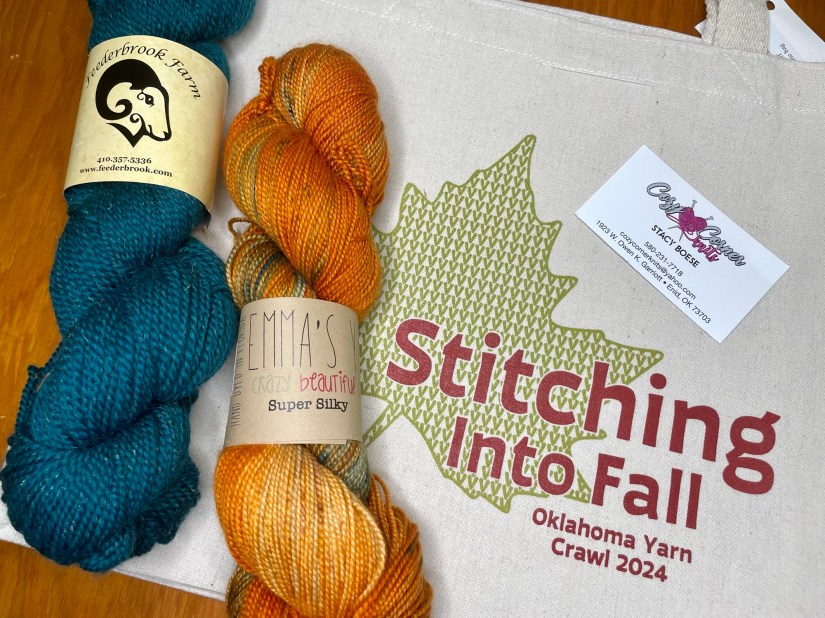
I stuffed some yarn with subtle sparkle from Feederbrook Farm and some gorgeous orange Emma’s Yarn Super Silky into my yarn crawl tote, and we were off to the next one.
You can learn more about Cozy Corner Knits at their Instagram or Facebook pages.
It was about an hour’s drive to our second stop, Susan’s favorite of the trip,
Oklahoma Mini Mill – Guthrie
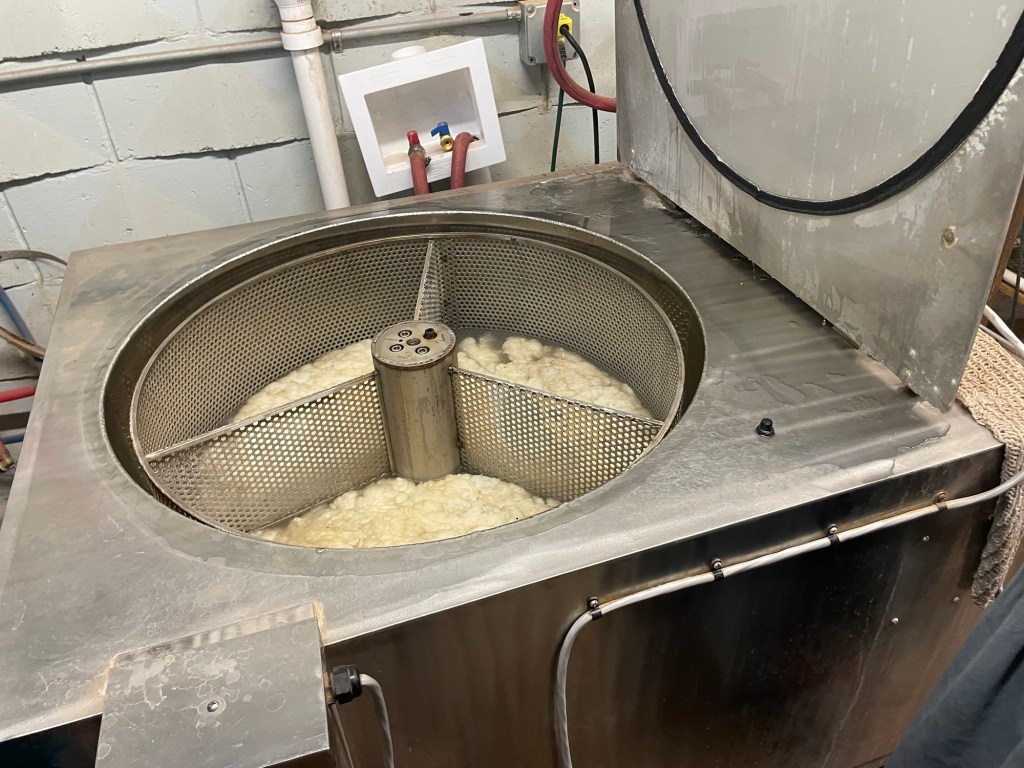
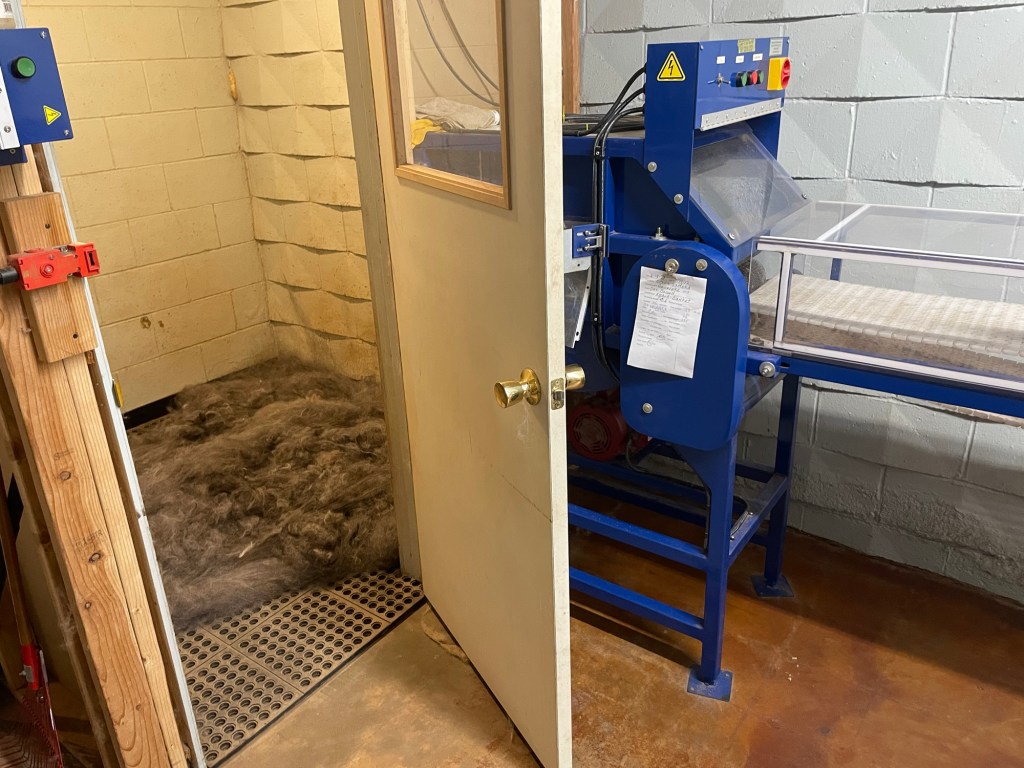
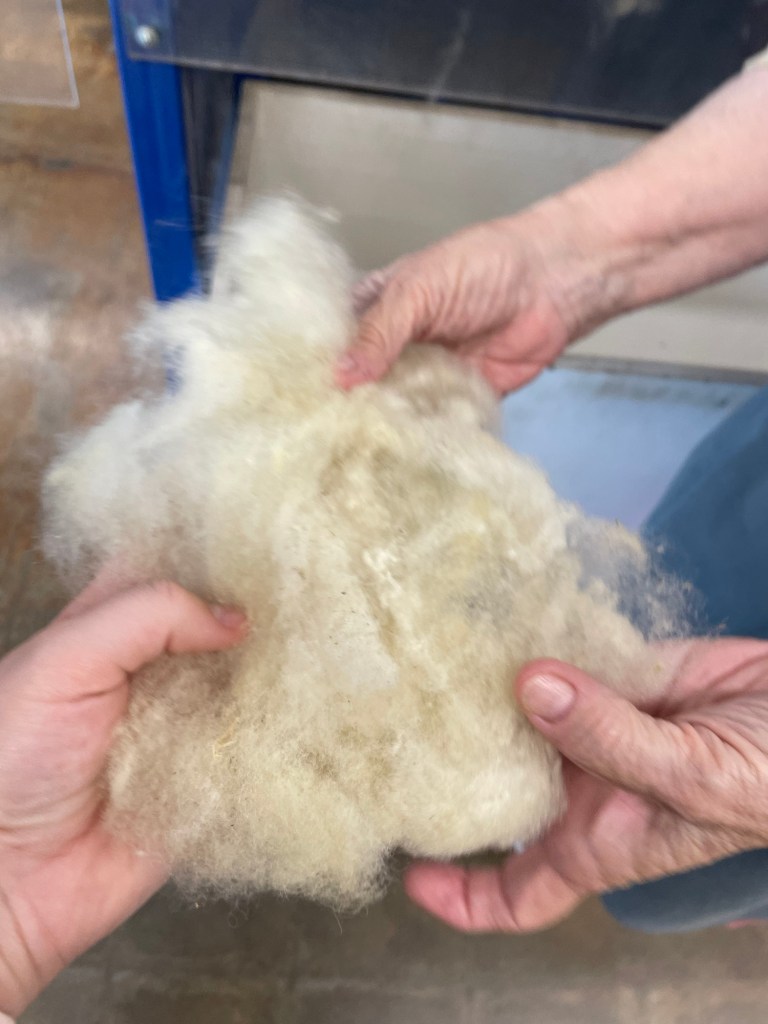
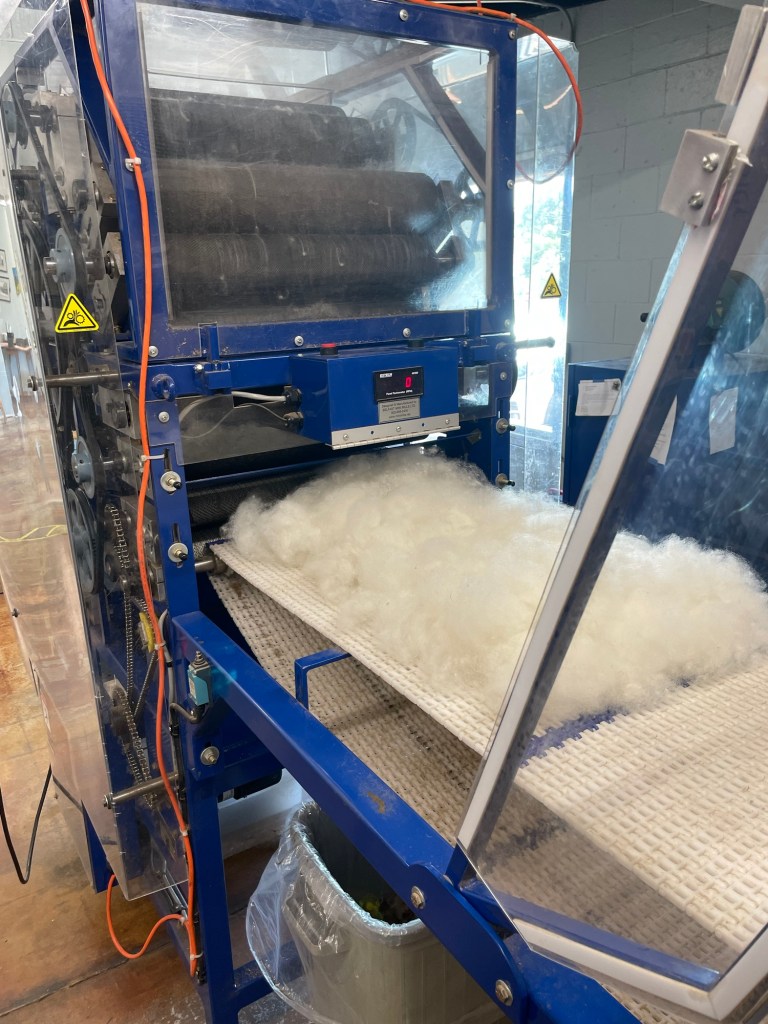
Oklahoma Mini Mill (OMM) isn’t usually open to the public for walk-ins since they’re a working mill and conduct most of their business online, but one of the owners gladly gave us a tour after she stamped our card. We got to feel some amazing fibers at different stages of processing. It was really interesting to be able to feel the different lanolin contents of wool as the cleaning and fluffing (industry standard term, I’m sure) progressed.
I’ve seen a friend hand process llama fiber before but never really paid attention to this part of the yarn process before, so this visit was very educational and interesting. We even got to touch some amazingly soft bison fiber that costs around $30-35 an OUNCE, and I think that’s the cost before processing.
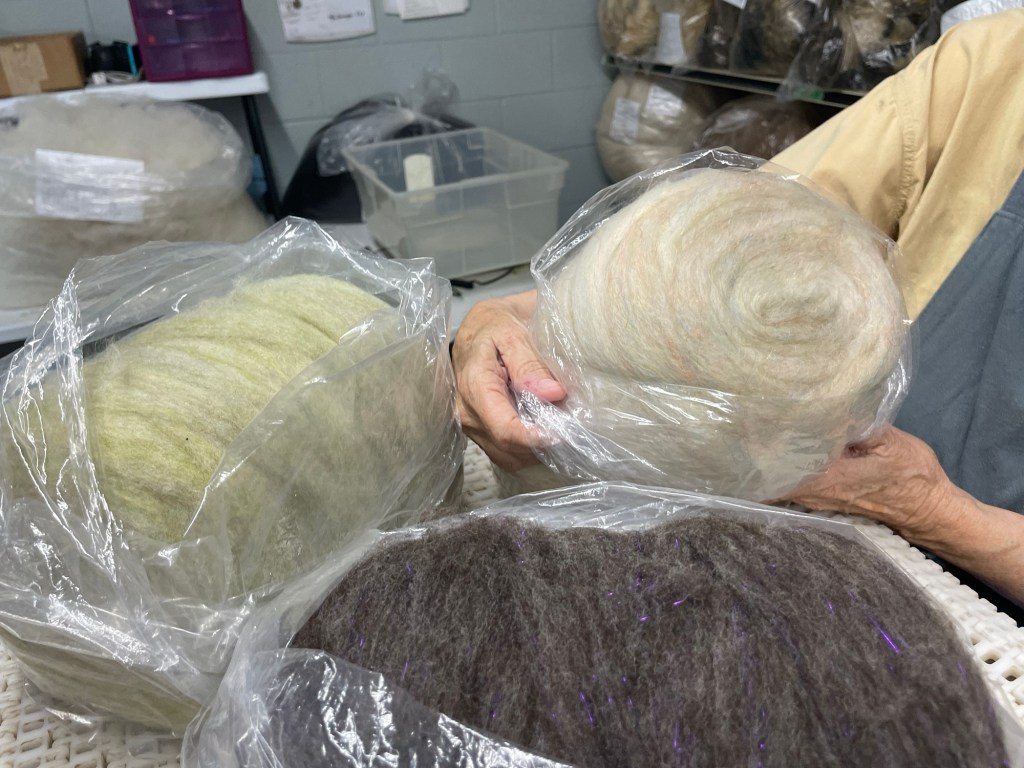
Oklahoma Mini Mill mainly focuses on processing fleeces for hand spinners, so they process fibers until they are ready to be spun but don’t do the actual spinning. Customers send their fibers to be cleaned and blended into fiber batts. They can even add in special things like this angelina sparkle.
Another neat factoid about OMM: They don’t waste any wool! Pieces that aren’t suitable for processing and spinning are saved and used as insulation.
I didn’t purchase anything from OMM while we were there during the yarn crawl. Most of their business is actually online through Etsy, which I’ll link below.
Oklahoma Mini Mill also vends at the Fiber Christmas in July show, so there is yet another incentive to attend Fiber Christmas if you haven’t yet!
You can learn more about Oklahoma Mini Mill at their website, Instagram, Facebook, or Etsy pages.
Guthrie had two stops on the yarn crawl. Next up was in historic downtown Guthrie
Sealed with a Kiss – Guthrie
Sealed with a Kiss brought in trunk shows and debuted HowdyDo, a new locally dyed yarn inspired by the women of the Wild West, during the yarn crawl.
We missed their Lunch in the Loft event by a couple hours because I forgot to check ahead with every yarn crawl stop like I meant to. Learn from my mistakes and check each shop ahead while planning!
Sealed with a Kiss had a really nice selection of knitting accessories as well as bags, fashion accessories, and even some non knit garments. It’s a yarn boutique but not just a yarn boutique.
I bought a wonderfully sparkly shawl pin. I just can’t resist sparkles.
You can learn more about Sealed with a Kiss by visiting their website, Instagram, and Facebook pages.
Susan and I got a hotel in Edmond for the night that ended up being less than 10 minutes from our next stop
Kristy’s Fiber Arts -Edmond
Kristy’s Fiber Arts is a dyeworks that features Kristy’s hand dyed yarns with a few other yarns alongside them.
Susan and I grabbed a coffee and waited in the parking for 10AM, the daily yarn crawl start time, but Kristy saw us and another group in our cars and invited us all in early.
We had a great time browsing and chatting, and Kristy shared a little bit about how she names her colorways. A lot depends on who or what she’s thinking about when she dyes. Mine would all end up being named after my chickens or food!
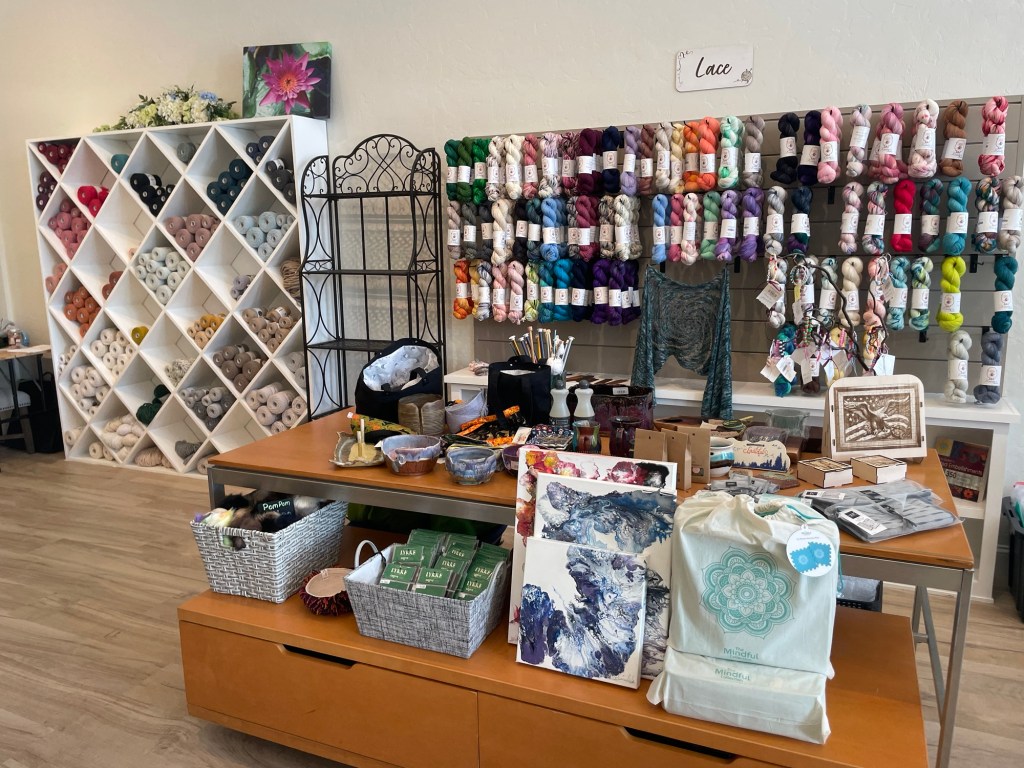
Yarns were organized by weight. I love to see hand dyers working with more than just sock weight yarn. I want those pretty colors and one-of-a-kind skeins in lace and bulky weights, too!
Kristy also stocked pretty macrame cord, so I made note of that for my mom, who does really nice macrame work. It was the most colors of cord I have ever seen in store, so if you like macrame, Kristy’s Fiber Arts is a great stop for it, too!
I bought some orange yarn and a mini skein kit from her at Fiber Christmas in July this year that I really liked, so I was excited to see what I missed that she’d have in store. The green and black yarn made me think of my younger brother, so Merry Christmas to him! I hope he’s not tired of beanies!
The next stop was also in Edmond-another dyeworks.
A Chick That Knitz – Edmond
A Chick That Knitz used to be a “full blown” yarn shop a few years ago, but they weren’t as able to focus on dyeing yarn as much as they wanted, so they took a step back and opened as a dyeworks with exclusively their own yarn and limited days open to the public.
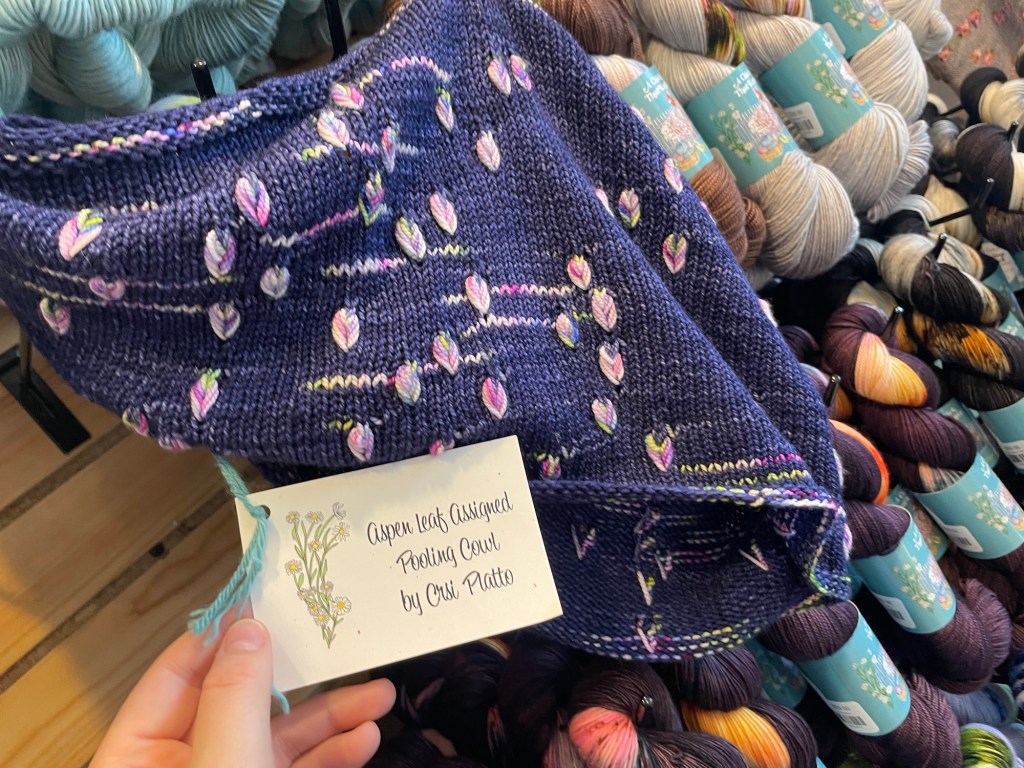
I’ve followed A Chick That Knitz online for quite a while, and I was excited to see their planned pooling yarns in person. The concept is simple— knit in one stitch, perhaps stockinette or garter stitch, for the main color of the yarn until you come across the color pooling bit (this is the section that isn’t the main color) and perform a special stitch.
It’s simple enough, but because each hand dyed skein is unique, it really enables you to create a one-of-a-kind item.
A Chick That Knitz has much more than just planned pooling yarns, but those were something I had been waiting to see for a long time because they’re how I learned about this way of using planned pooling. I’m in their area a few times a year, but the timing never lined up before to be able to see their space, so I’m glad I finally got to experience it during the yarn crawl.
I bought planned pooling yarn from their website after the yarn crawl ended.
You can learn more about A Chick That Knitz at their website, Instagram, and Facebook pages. Also look at their cool chicken logo!
The cloud ate my pictures from our next stop alongside most of my pictures from A Chick That Knitz, so I’ve linked some of their Instagram posts to show you their space.
MoonDrake Co. – Oklahoma City
When we reached MoonDrake Co. dyeworks in Oklahoma City, it started to hit me that our yarn crawl journey was almost over. The public part of the shop is on the small side but is nicely organized. Wool and dye scents wafted from the back room, and I really enjoyed that. Wool and lanolin smell is so comforting to me.
Because the display area was smaller, it was easy to see the many different types of yarn bases MoonDrake uses in their yarn lines.
I went home with a large skein that was actually two skeins —one of a stubby yarn and one of a cashmere/mohair blend— that were meant to be worked together into the same project. I also purchased a really pretty neon tweed yarn that I am looking forward to working with.
I really wish my photos hadn’t been eaten because the display did a really good job of telling the neon tweed line’s color story. They’re gorgeous, vibrant, and fun.
Our final stop on the 2024 Oklahoma Yarn Crawl was
Yarnatopia—Oklahoma City
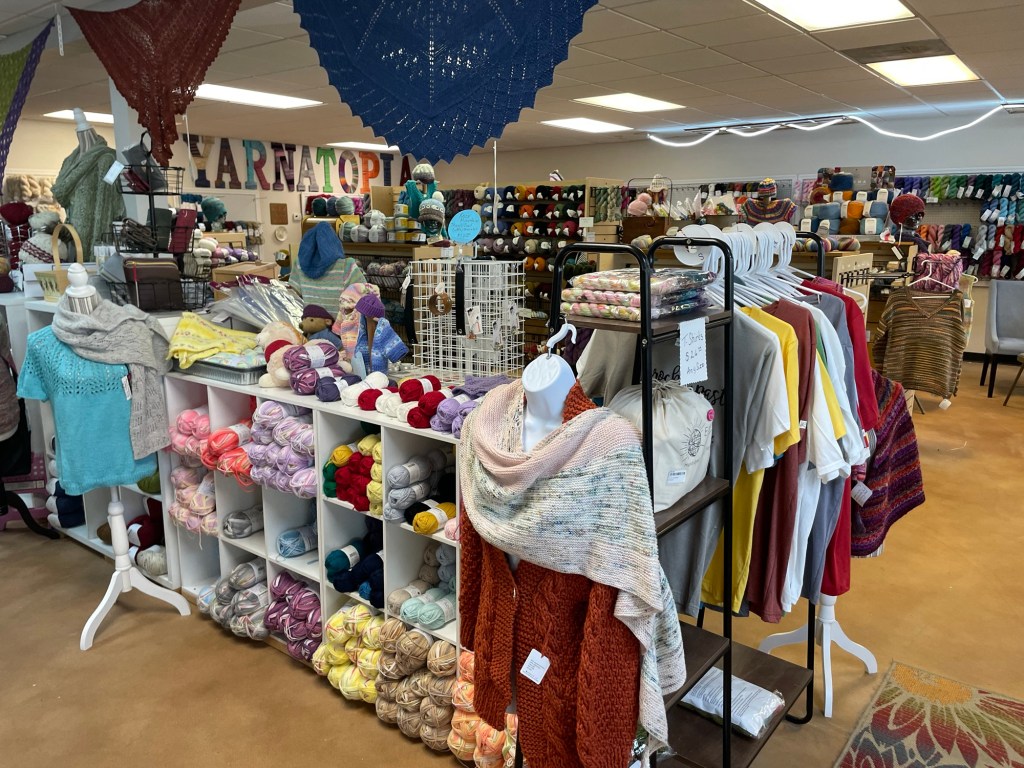
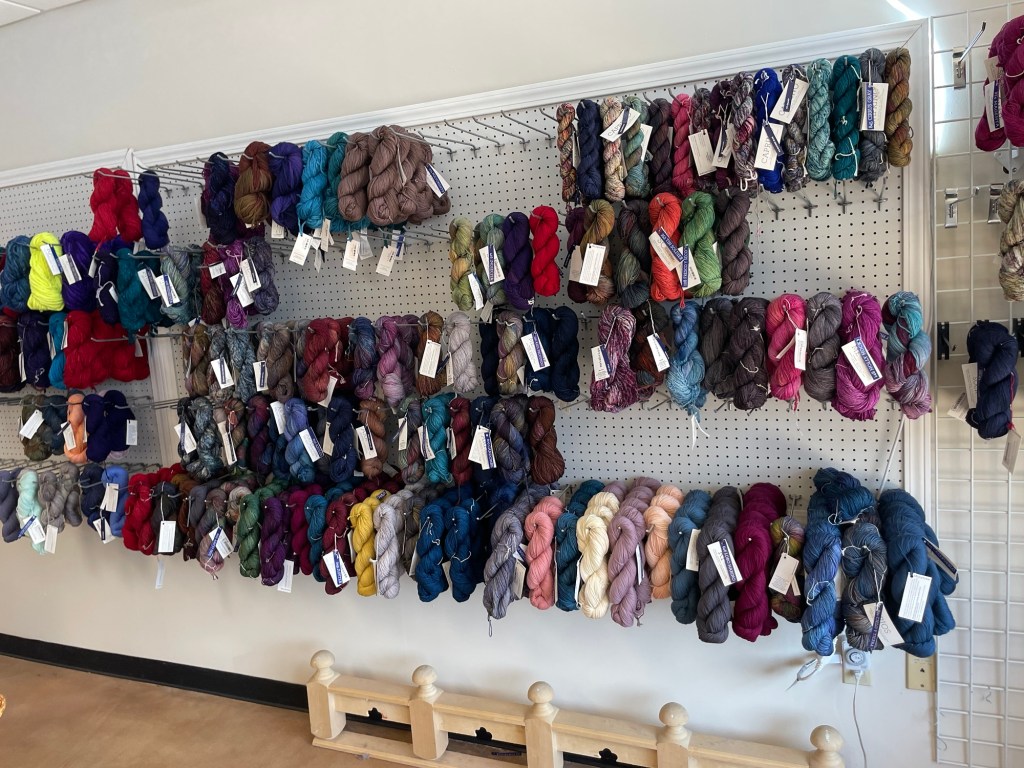
I’ve been to Yarnatopia a few times over the years, having pleaded with Chris to stop by on the way to or from visiting family. I really enjoy stopping by. The shop is a very nice size and has a really nice Malabrigo yarn wall. I know others appreciated it, too, because it had been picked through by the time we got there, and the yarn crawl had two days left!
I found some really nice “hi-viz” yarn to make a hat for my dad (he always requests a hat for Christmas) and a very nice slub yarn by Emma’s Yarn. (I tried to buy from all different brands but didn’t realize the sock yarn I bought from Cozy Corner Knits was also Emma’s Yarn. Guess that means I need to look into that brand more since I really like what I’ve seen so far!)
I really like the “Yarnatopia” yarn-wrapped letters on the wall, but I don’t think Chris would go for that in our house….
We were both pretty tired at the end of the Yarn Crawl and had a two and a half hour drive back to my place. Susan had another hour to go after she dropped me off. I think we’ll attend a few more days of the yarn crawl next year rather than trying to squish everything into three total days. We’ll be able to spend more time at each shop and participate in events that way, too.
Every shop owner I talked to seemed very excited about the results of the yarn crawl for their business, and the crawl still had three days left to go when Susan and I made our way to the central Oklahoma area shops.
Many of the dyers had sold out of colorways and had to tell crawlers when they’d be back in stock. I ended up making some purchases online or through Etsy after the official crawl dates were over to find colors, bases, and fibers I liked the most.
I knew of many of these businesses before the yarn crawl, but I had only managed to visit about half of them before the event. I have family in the western part of the state, and I’m already thinking up alternative routes that would allow me to drop by and see shops again on my way out and back home.
The yarn crawl did a great job showcasing how amazing and varied the Oklahoma fiber community is. I loved seeing each dyer’s different color stories and the variations in each shop’s different brands and specialties.
I had a wonderful time meeting Oklahoma’s fiber talents, and I can’t wait for The Second Annual Oklahoma Yarn Crawl 2025!
Thanks for joining me on this road trip recap of the 2024 Inaugural Oklahoma Yarn Crawl! Have you ever been on a yarn crawl as a customer or as a host? Do you plan your own yarny road trips?
Christmas Covid is the gift that keeps on giving, and recovery has been rough. It’s Fiber Christmas In July time already!
I’ve been through a slew of tests with more to come, but I’m finally able to break through the covid brain fog enough to feel confident writing again.
My yarn rep stopped by a few weeks ago and gave me some yarn samples for inspiration, so I thought I’d share my opinions with you.
Disclaimer: All opinions are honest and my own. I was given this yarn for free with no expectation of review or endorsement.
Jody Long Delish
is a 50/50 extra fine merino wool/mulberry silk blend you will want to pet and squeeze repeatedly the second it gets into your hands. The color palette is well-rounded for a that is newer to the market with a nice blend of neutrals, pastels, and brights in its 16 colorways.
With an MSRP of $19.99 and MACHINE washable and DRYABLE labels on the tab, Delish seems almost too good to be true. Skeins are 50 grams each with 230 yards per skein (that’s about $0.09 per yard), which makes sweater quantities (1200-2200) fall in the $120-200 range. For a luxury yarn, that number feels about right.
Delish is OEKO TEX and Mulesing Free wool certified.
I carried my sample skein in my purse for days and made all of my friends squish it and rub it against their face. It feels amazing.
How It Worked Up
Delish flew through my standard gauge machine at Tensions 10 and 8, and I suspect it would be nice even at Tension 6, although that might produce a fabric that is too tight to show off the yarn’s wonderful drape. According to the label, Delish is a CYC 1 Superfine/Lace weight with a recommended hand knitting needle US3 and crochet hook D. It is a good yarn weight for lace work and could also be treated as a light fingering weight yarn with nice results.
Machine Compatibility
Standard
✔ worked amazingly
Mid-Gauge
✔ lower tensions
Bulky
✔ will work, but not the best choice
My sample skein was only 25 grams (retail version is 50g), so I didn’t test at as many tensions as I ended up wanting to.
I had zero issues with yarn breakage or tangling, but this yarn will stick to itself if you give it the chance. I ran into quite the yarn tangle while winding it into a cake on my yarn swift.
Laundry Care
I was most excited about the machine washable and dryable aspects of this yarn, and while the label is technically correct— you can do it— you shouldn’t.
My swatches did not appreciate being machine washed, and the second I pulled them from my machine, I wished I hadn’t done it.
Delish developed a very nice halo after washing, but it was also pill city. That doesn’t bode well for high-wear areas in garments.
halo and the beginning of pilling
The yarn also lost a lot of its pleasant sheen.
Here’s a refresher on how I treat my swatches when testing yarns:
Fresh off the machine — Set Stitches, Lay Flat, Measure, Record Gauge
Hand Wash, Flat Dry, Measure, Record Gauge
Machine Wash Cold, Flat Dry, Measure, Record Gauge
Machine Wash Cold, Machine Dry, Measure, Record Gauge
I think this method gives me a good feel for how a yarn will wear when worn. If I am concerned about a fabric dropping or I know the garment will be particularly heavier, like a skirt, I will hang the swatch and put a claw weight on it for a few days to simulate the weight and pull of the garment.
Always treat your swatch like you will treat your finished object!
A small part of me knew the machine wash and dry labels were probably too good to be true. I was disappointed, yes, but Delish did maintain its drape and wonderful hand feel after machine wash. It lost a bit of its sheen/vibrance after washing, but the halo was a nice trade off. The pilling wasn’t unexpected since the yarn does like to stick to itself, but I will note that the pilling issue wasn’t as present with hand washing.
Final Thoughts
Jody Long Delish is a really nice, luxury yarn at a decent price. It flows well through a knitting machine and wears fairly well if you treat it like a luxury yarn—which means NO machine washing or drying. (This may be a hot take, but if you put in the time and money for a sweater’s worth of yarn, you should be hand washing it anyway.)
I have to be very picky about what I spend my energy on now with Long Covid, and I’m probably a little more disappointed that I might’ve been in the past about the machine washable and dryable aspect not turning out as well as I’d hoped.
I still plan on buying some of this yarn.
While I originally wanted to make myself a nice cardigan using it, I think making a lacy shawl will show off the yarn’s wonderful drape and feel and take advantage of its lightweight warmth while avoiding the inevitable pilling in the higher wear areas of a cardigan.
Thanks for joining me on my machine knitting journey! I love hearing from you!
Contact me if there’s something you’d like me to cover in future posts, or feel free to leave your thoughts in the comments.
In-person classes are on track to resume at Get Stitchin’ in October. I am in the process of getting internet access in my studio for future Zoom classes and streaming sessions. Hooray rural life!
If you have a little bit of Christmas Cash and you feel like investing in yourself for the New Year, pick up the newly-released Texture and 3D Effects Machine Knitting Techniques book. Amber Hards teaches texture and playfulness in her essential addition to the series.
“[Hards] encourages you to explore and experiment with confidence to produce exciting, tactile knitwear.”
Amber Hards is a UK-based knitwear designer and maker who has been teaching machine knitting since 2016. Her website showcases years of her work, and I encourage you to give it a look. I especially recommend viewing her “Loving Love” show. You can see why those behind the Machine Knitting Techniques series enlisted her aid with tactile knitting!
The Crowood Press set a high standard for photographic instruction with their Machine Knitting Techniques series, and Hards meets that here. Instructions are clear with illustrative photos. Hards uses color contrast strategically to illustrate steps and movement of textures, but the generally monochromatic palette helps you visualize the textures of the stitches.
The “Pattern Collection” at the end of the book is a bit underwhelming with only two patterns, but remember that this is a technique book. The focus is, as it should be, on technique instruction.
Practicality
“When I show students more textured skills, they often express feeling overwhelmed by the process. As different techniques are often presented as all-over swatches where the stitch or technique is packed together throughout the swatch, many of these textured effects often feel too “runway” or high fashion for a beginner or casual machine knitter. “Where on earth would you actually wear that?” is a common question.
You don’t have to use these techniques all over! A large shawl completely done in one technique can be stunning, but remember that small, pinpointed uses of these details can add to an otherwise simple garment.
This partial knitting shawl I made in 2019 looks like a myriad of connected i-cords or winding snakes of stockinette stitch. It was created by moving groups of needles in and out of work.
Designer Linda Jensen uses the same technique for the bodice of this Ripple Top. Confining it to one part of a garment doesn’t diminish the visual interest this stitch generates. It just refines it.
Pintucks in the shoulder area add interest to an otherwise simple October Cardigan by Jesie Ostermiller. Using them over an entire cardigan could be interesting, but confining the texture to one area created a way to draw the eye upwards.
This October Cardigan was knitted on my Passap Bulky Eight and was one of the first machine knitted projects I created.
It’s not perfect, but I learned so much making it!
Why don’t you try choosing a technique from Texture and 3D Effects and place it in a similar location as the pintucks in this cardigan?
Buy or Bypass?
Of the Machine Knitting Technique books released so far, I suppose you could skip this one, but I think that would be a mistake. Developing skills like these can help you in your other works. Paying attention to how textured stitches are weighted while you knit them, for example, helps you become more aware of your work as it sits on the machine.
Texture and 3D Effects might feel like it is written more for the aspiring designer than your everyday machine knitter, but let’s face it- if you are a machine knitter, you need to learn to be comfortable being the designer yourself because of the lack of available patterns.
Hards encourages playfulness in machine knitting, and I applaud that.
⭐⭐⭐⭐⭐
Rating: 4.5 out of 5.
I hope you’ll explore your creativity on the knitting machine even more this year and realize that you might just already be a designer.
Happy 2024!
Thank you for joining me on this machine knitting journey! What texture technique from the book will you try first? Let me know in the comments!
Disclaimer: Links on this site may be Amazon Affiliate links. If you choose to purchase an item using my affiliate link, I may receive a small commission at no cost to you.
If you don’t have a local shop to support, please consider using my link and supporting the site!
I purchased this book with my own money. All opinions are honest and my own.
If you would like to submit a book, yarn, accessory, or other idea for review, please contact me through my contact form.
It’s fall, y’all! …well, it is autumn according to the calendar.
Sweater weather hasn’t fully arrived yet in Northeast Oklahoma, but I am here for you with a seasonally appropriate review of Brown Sheep Nature Spun Sport 100% wool yarn ON CONES!
Before we get into my knitting experience, here are
Additional Info •This yarn will felt if you do not follow proper care instructions. •NatureSpun is treated with a moth proofing agent at the time of dyeing that makes the wool “unpalatable to the wool moth larvae.” (See their FAQ page for more details.) •The main wool breeds used are Corriedale, Rambouillet, and Columbian. •This construction is available in fingering, sport, worsted, and chunky yarn weights. •Sport and Fingering are the only options that come in cones.
mid-work on a standard gauge knitting machine
Machine compatibility
4.5mm Standard
Yes
6.5mm Mid-Gauge
Yes
8mm / 9mm Bulky
Yes
Mid to high tensions felt best on a standard gauge machine. Low-mid tensions felt appropriate for the mid-gauge machine. Low tensions are appropriate on a bulky machine unless you plan on using specific techniques that require looser gauge.
(If you’re wondering, I knitted the pictured sweater at Tension 5/5 for the ribbing and Tension 10 for the colorwork.)
What I’m Looking For
I’ve laid out what I’m looking for in a book in recent reviews, but I haven’t really talked about what I want in a yarn. The completely unhelpful answer is “It depends.”
It’s about purpose.
Am I indulging myself in a luxurious, expensive specialty garment, or am I making a jacket I am going to wear every single day? Is the item for someone who will take the time to properly wash it, or is it for a busy new mom who barely has time to think, let alone check the care label on some knitting she got from Auntie Em?
I want to say I’m a bit of a yarn snob because the yarns I end up choosing for personal projects tend to be hand dyed from indie dyers that are specific wool breeds. I want that handmade, one-of-a-kind element to be there from start to finish.
But I can also appreciate acrylic and will argue that has its place in your stash alongside your finest, rarest fibers.
My considerations boil down to •Will this work on my machine(s)? •What is its purpose (everyday workhorse vs luxury) and does it meet it? •How does it feel on my skin? •Is it easy to care for as a gift? •What are the color options? •Is it sustainable/renewable? (This can be difficult to answer depending on the amount of information available) •How does it block? •Does it match the claims it makes? (i.e,. “just like silk!”) •Is this going to be discontinued just because I like it?
I’m kind of kidding with that last one, but I’ll admit I’ve started to stay away from brands that are always introducing new yarns and then discontinuing them after a year. If it’s gone by the time I get to knit with it and I can’t find more, why bother even trying it? That’s a major yarn peeve!
Speaking of yarn peeves, you may not mind these things, but I sure do!
•Knots in low yardage skeins •Knots in general •Donut put-up •Quickly discontinued •Splitty construction •Loose/easily lost labels (especially those wrapped but unsecured labels on those dang donuts)
Nature Spun has a great selection of colors. The two colors I used, Autumn Leaves, an olivey chartreuse, and Pomegranate, an autumn red, had very nice depth of color due to a tiny bit of added black. It really made the colors pop.
With more than eighty vibrant colors spun in four different weights, the possibilities are unlimited for creating something beautiful with Nature Spun.
BrownSheep.com
When I think of 100% wool yarns, I think “scratchy,” but that isn’t the case with Nature Spun. It is a bit more textured than a chemically treated superwash wool yarn version, but that is normal.
Nature Spun is pleasantly soft and squishy with a bit of a size bloom in the twist as it comes off of the cone. Brown Sheep Company classifies Nature Spun Sport as a CYC 2 yarn weight, but I wouldn’t call you wrong if you said it was a light DK or CYC 3 weight, as it is on the heavier end of “fingering” weight yarns.
in bright sunlight, true to colorcolorwork and ribbing stitch definition
This yarn flowed very nicely through my machines. I didn’t encounter any breakage or splitting, and when I needed to un-knit a few rows due to a punch card mispatterning, it didn’t cling to itself or create fiber halos around the strand of yarn as I unraveled it. It did shed a slight bit of fuzz as it went through the knit carriage, but others wools I have worked with shed the same amount.
having a soak
I lightly steam blocked the sweater pieces before putting the sweater together. After a bath in some Eucalan, I wet blocked the finished sweater.
The yarn bloomed a tiny bit more after a steam and a soak, but the stitch definition is still nice and clear.
This wool is WARM. Much too warm for Oklahoma in general, but I had to try it on even if it was 82F outside when I finished. If you’re at higher latitudes, this should keep you very warm in the winter.
If you’re picky about your yarn’s sourcing, Brown Sheep Company says it sources its wool from local growers, and the entire process save wool scouring, carding, and combing is done at their Nebraska location. Plus, they are family owned.
Final Thoughts
This yarn is much nicer than I expected it to be, especially as a nonspecific wool blend at $0.03 per yard. Brown Sheep Company’s product listing claims “breathability, resilience, vibrancy, and warmth,” and I haven’t experienced anything to contradict that.
I joked with my husband that we needed to buy a building downtown and open up a yarn shop just so I can get a wholesale account with Brown Sheep Company. I really enjoyed working with this yarn, and I plan to purchase more of it. I personally don’t mind its care requirements, but if you plan to gift an item made from this, make sure your recipient knows how to wash it. It’s basically a one-season/winter only garment yarn in Oklahoma, but I think it’s worth it. I give it a solid
⭐⭐⭐⭐⭐
Rating: 4.5 out of 5.
Brown Sheep Nature Spun Sport on Cones is a workhorse yarn you’ll want to add to your stash.
Thanks for joining me on my machine knitting journey! I hope you’ve enjoyed my review. What factors do you consider when judging yarns? What do you want to see next on the blog? Let me know in the comments or contact me through my site form.
Disclaimer I purchased this yarn myself. All opinions are honest and my own. Amazon product links may be affiliate links. As an affiliate, I may earn a small commission at no cost to you if you choose to use my link. If you don’t have a local place to support, please consider supporting the site and using my link.
In my last post I showcased a project where I used NINE colors to push my creative boundaries. I ended that post feeling more confident, but when I went to choose colors for my next colorwork project, I found myself even more color-shy than before!
Since I’m still not convinced I know enough about colors to be allowed to choose combinations on my own, I thought I’d share different ways to choose a color palette that will help you build and discover your own color stories.
Use a Color Wheel
To me, using a color wheel feels like the “pro” way to choose colors. It’s the way “real” artists do it, or so my head says.
(I’ve considered myself a “real” artist for a while now, and I only just bought a color wheel, so let’s all remember to ignore those negative “not a ‘real’ artist” thoughts if they pop up, okay?)
If you don’t have a color wheel and/or a local place to buy one, please consider using my Amazon Affiliate link to support my site! I may receive a small commission at no cost to you, and it helps me keep my content free.
This post from Felt Magnet explains how to use color wheel and defines the associated terms. There are lots of other great posts on Color Theory and color wheels out there, so search up a few and give them a read if this one wasn’t enough for you.
I bought my color wheel from the Across Generations natural dye booth at the Fiber Christmas in July fiber festival. She doesn’t seem to have any in her Etsy shop, but her colors are so amazing and inspiring that I wanted to make sure I linked her because you can …
Use Your Favorite Artist’s Colors
You like them for a reason, right? If you aren’t confident enough to trust your gut, trust someone else’s!
Since most artists now have websites and/or social media, you can keep up with their work without going to galleries.
Find a piece that speaks to you and identify your favorite colors from that piece.
From my slightly overwhelming experience with nine colors, I suggest you start with just two or three.
Kacy Latham is my favorite artist, hands down. I love the way she plays with bright colors and texture as well as the way her shapes flow. We actually grew up in the same town, and while I don’t know her well because she’s a bit older than me, I’ve followed her art journey for years now. She is constantly pushing herself to create and share her work, even painting numerous public art pieces for the residents of that tiny town in Texas to enjoy.
What colors would you choose from this piece from Kacy’s Instagram?
I chose the darkest navy blue from the top right and the rosy, bronze-y brown just left of middle.
Follow Indie Dyer Collections
Don’t forget your favorite fiber artists!
If you keep up with your favorite dyers on social media, look through their feed or ask them how they choose their colors when you visit their booths at fiber festivals. Jenny at 316 Dye Studio recently released an entire collection inspired by Bob Ross paintings!
Sometimes indie dyers will even feature curated palettes of their yarns, so it’s worth it to go see what they’re up to when you’re looking for color inspiration.
Go Through Your Finished Objects
Even if you’ve knitted it up already, take a look at your favorite yarns and completed projects and try pulling your color palette from them, especially if you used a kit or a yarn with an existing color palette.
I don’t even know where this scarf is right now…
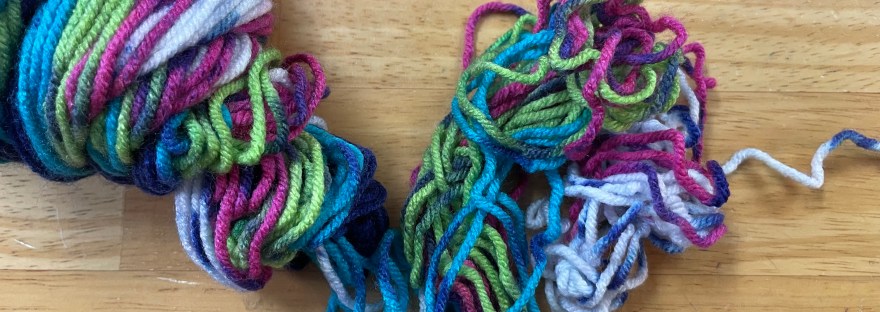
I hand knitted this Gallatin Scarf back in 2016. I hated the yarn but loved the colors. The self-striping element made knitting through the pattern interesting, and I can see this palette being perfect for a floral colorwork sweater.
Use an App
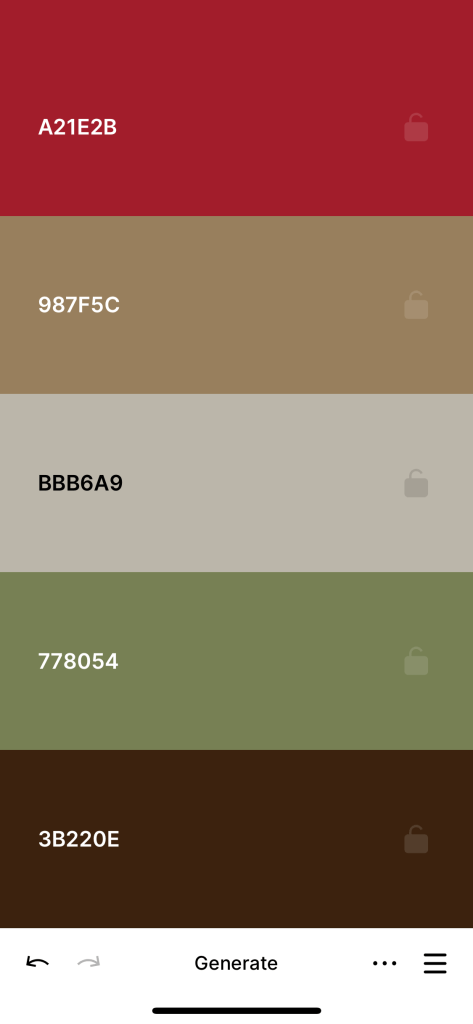
As mentioned in my Confronting Color post, you can browse a color palette app like Coolers.co for inspiration. You can also create your own palettes with up to five colors without a Pro subscription.
My favorite feature might be pulling a five color palette from an existing image.
sunflower from my gardenmy friendliest breakfast layerGoldie’s Palette
You simply drag the white circle selector to different colors to change what it generates in your palette.
Canva.com also has a similar image palette generator. I’ve only used the free versions, but both Coolers and Canva have additional features in their subscription only tiers.
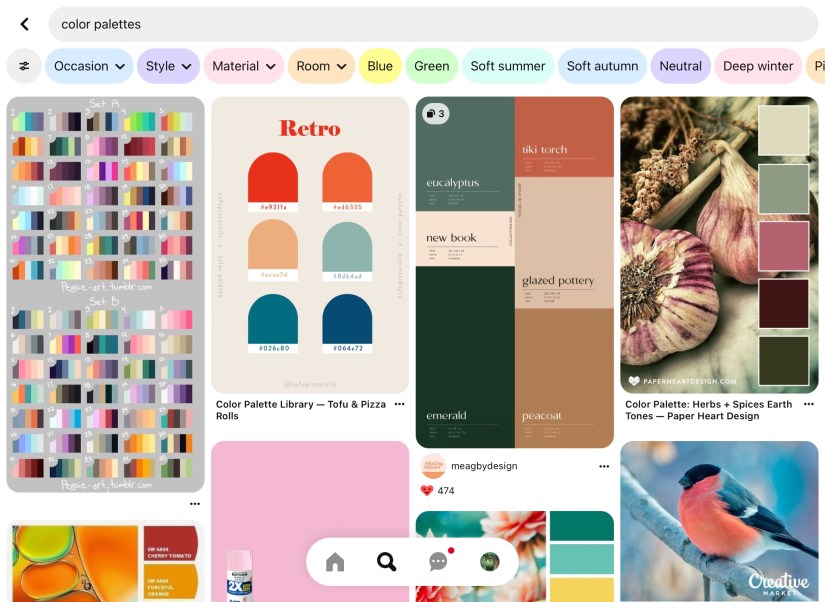
As ad-filled and misdirected as its links can be, Pinterest is still perfect for making mood and inspiration boards.
Ask Around
In addition to having fiber suggestions, your local yarn shop is a great place to ask about color combinations. Since the owners have likely already ordered for the coming season, they might be able to point you in the direction of future color trends.
Your LYS’s staff probably aren’t the only helpful people around in your fiber community. In my experience, there’s always at least one regular who everyone counts on for their color choosing capabilities.
Get Stitchin’, where I teach lessons, in Tulsa, OK almost always has a trunk show rotating through the shop. She also carries yarns and fiber from local specialists, so if you don’t have a favorite indie dyer or fiber farm, you will soon!
You probably have a local shop closer to you than you think. Ravelry has a Local Yarn Shop Directory, and most yarn brands have a stockist locator on their website. If you don’t have a local shop to frequent, I hope you find one soon!
How do you choose colors for your projects? What other ways should I try to find color inspiration? Let me know in the comments!
Thank you for joining me on this colorful leg of my machine knitting journey!
Knitting machines can use a range of yarn from all kinds of put-ups like we saw in my last post, but the easiest and best put-up for machine knitting is cone yarn. Cones don’t need extra preparation before use, have more yardage in general, and often feature unique textures or colors that you might not find in hand knitting yarns.
If cone yarn is so great, why is it harder to find?
In the USA, machine knitting isn’t as common as it once was. While the hobby is growing again, it’s kind of seen as a niche within a much more popular one or even as “cheating” at hand knitting. Yarns made and wound on cones specifically for machine knitting aren’t really a thing here anymore.
On the retail side, cones are larger and more difficult to display compared to other put-ups. Most shops don’t have the shelf space to dedicate to a few 1-2lb cones that would otherwise be filled with 10-15 skeins or hanks. Many hand knitting or crochet projects don’t need the thousands of yards that can come on a cone. Additionally, shipping cones generally costs more for the number of products you get than other, smaller put-ups.
The downsides of retail shouldn’t keep you from using cone yarn in your machine knitting.
Let me butter you up a bit, reader. If you’re a machine knitter, you already work harder to find your materials, parts, and resources than other yarncrafters have to because of that niche! A little work to find cone yarn is nothing to you, right?
Finding Cones Locally
I’m a big believer in shopping at local small businesses whenever possible.
So please,
Check Your Local Yarn Shop
Maybe they have cone yarn and you missed it! It’s easy to get distracted among the beautiful colors and textures in a yarn haven. Trust me, I understand.
If your local yarn shop doesn’t stock cone yarn, ask them about it!
Most shops are happy to accept special orders. **Please keep in mind that many distributors have a minimum dollar amount to place an order for new accounts, so it may take your LYS time to reach that amount depending on their size. Pay up front and work with your local shop so you both benefit! Convert your yarn friends so more of you need cones! (No downsides to that one, right?)
Get Stitchin’, the shop where I teach lessons, recently became an Ashford dealer. Now they have 0.5lb Ashford cotton yarn cones alongside their Ashford spinning wheels and looms! Those gorgeous yarns work wonderfully on 4.5mm standard knitting machines. The owner is happy to order other yarns in, too. I just have to ask!
Oh, speaking of looms,
Ask the Weavers!
Ask your weaving friends or your region’s weaving guild where they source their coned yarns. Many of them will use hand yarns, but those who work with finer yarns will often use cones. (If you don’t have any weaving friends yet, try to make some! Weavers are fun!)
Chat with the Regulars
I live in rural Oklahoma. Most people probably think of Native Americans and buffalo when they think of the state. They definitely don’t think of yarn.
That doesn’t mean hand or machine knitting doesn’t exist here, it just means I had to look a little harder than someone in a big coastal city or European town might’ve had to.
As some of you know, I used to work at a yarn shop in the suburbs that focused on hand knitting and crochet. When my hands started to deteriorate (I talked about it in this post), I had to start looking for other yarn craft options.
I saw Addi circular machines online, but I had never heard of a flat bed knitting machine. I mentioned my machine research once at the old yarn shop with the other regulars, and wouldn’t you know, one told me about the Fiber Christmas In July festival, a wonderful local fiber festival, and a vendor there who specializes in machine knitting!
Who knows how long it would’ve taken me to figure things out if I hadn’t stuck around and chatted with the yarn shop regulars?!
My teacher and mentor Pamela Carrico is the fiber artist specializing in machine knitting that customer told me about. Her shop has both hand knitting yarns and machine knitting cone yarns! She has new old stock vintage yarns as well as quality acrylic 2/24 yarns that she sells by the pound, which is really helpful if you want to do a colorwork project but you don’t want to pay for pounds of yarn colors you may only use once.
Asking around helped me find an instructor and materials in one place!
Things worked out wonderfully for me, but what if you don’t have a local yarn shop or yarn community? Making your own is always an option, as is joining an online one.
If you don’t have a local yarn shop, please consider finding a small business online and supporting it before you turn to a big box store. You’re more likely to find someone who can really help you find what you need at a small specialty shop, too!
Call (Yes, Call) Other Yarn Shops
I have the Millenial Aversion to Phone Calls. If you’re not a close friend or family, I much prefer text or email, so I understand there can be some discomfort in this tip.
But remember, many machine knitting shops have been in business for decades, meaning they have operated without texts and emails for a long time, so a phone call is going to be your best option, especially as they take care of things in store. Don’t forget to leave a message if you need to. Save the shop’s contact information so you know they aren’t spam when they call you back. (Yes, you’ll have to answer the phone, too!)
At the bottom of this post, you’ll find a list of shops that I know stock machine knitting cone yarn in the USA. If you know of more, let me know in the comments!
Some of these shops don’t have cone yarn listed on their websites but can tell you what they have when you call and ask. Many have “dead stock,” or discontinued cone yarns that are still perfect for knitting. They just aren’t made anymore.
Online Marketplace Listings
If you weren’t able to find anything with info from your LYS or yarn friends, try using Google, Craigslist, and Facebook searches for “<your location> cone yarn” or “<your location> machine knitting.” Don’t forget to check Facebook Groups that may meet locally or regionally, either!
Cone yarn is often listed in large lots from estate or garage sales. Since it takes up so much room, many people are happy to meet you somewhere and give you the yarn for an extremely low price or even free. I’ve found yarn like this several times. It’s worth checking regularly.
Set a search alert using machine knitting and cone yarn terms so you’ll know when something near you pops up. When you pick up your yarn, ask the seller about their source or where they learned about machine knitting and cone yarn.
If your local search doesn’t pan out, try some of these smaller businesses online:
Have you tried machine knitting with cone yarn yet? Were you able to source it locally? What are you planning to make? Let me know below in the comments!
Disclosures:
I teach hand and machine knitting classes at Get Stitchin’ in Tulsa, OK. I’m not paid to promote the shop, but things that benefit the shop often benefit me as people may purchase my work from the shop or sign up for one of my classes!
Carrico’s Creative Corner is my mentor’s shop. I’m not paid to promote her shop, but I happily mention it to support her and her work.
Shops listed are provided for informational and educational purposes and are not affiliated with me.
Thanks for joining me on my machine knitting journey! I hope you learned something useful today.
You might have encountered one of these problems before: the yarn stopped flowing through the tension unit and the tension wire bent all the way towards the carriage and needle bed, the carriage jammed, an entire row knitted at a much tighter tension than you wanted, the yarn broke.
If you are experiencing problems when you machine knit with hand knitting yarn, your yarn preparation (or lack of) might be the problem. Here are some things to consider about different yarn put-ups and the ways they can affect your tension while knitting.
various types of yarn put-ups
Hank Must be wound into ball or cake before use
Donut I absolutely hate the donut put-up, so I’m going to rant about it!
It does nothing other than look pretty on a shelf. Hand knitting will cause it to fall apart. Putting it in your bag after purchase will cause it to fall apart. Looking at the outer layer cross-eyed will start it on its slinking, unwinding, collapsing journey!
Unstable put-up Uneven tension Needs to be contained Flops around
Yarn Ball Can roll away Needs to be contained in a basket or bucket Yarn can get caught under the weight of large balls causing uneven tension
Skein Center pull often results in “yarn barf” and/or collapsing skein Needs to be contained Outside pull means flopping/traveling/rolling skein and uneven tension as yarn enters machine Outside pull means stopping after a row to pull out enough yarn to knit a row every time to avoid flopping
Cake Manual-recommended put-up for Silver Reed LK150 Flat top and bottom Should not roll Most even tension of all put-ups mentioned so far Require ball winder and swift
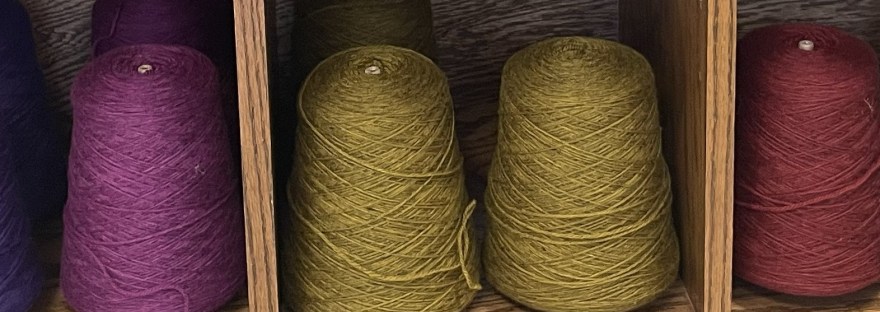
Cone Best put-up for machine knitting Even tension Large yardage Not a commonly used put-up for hand knitting yarn
You aren’t an awful knitter if you don’t knit from yarn cakes or cones! But they are the best put-ups that are least likely to cause issues.
I’ve knitted center pull from a skein before. Everything turned out fine, but I did have to stop and fix a few tension issues as I knitted.
I knit from yarn balls all the time, especially for scrap yarn. Sometimes they jump out of their container when I’m knitting quickly and I have to chase them down. It happens.
Knitting from less than ideal put-ups just means I accept I might encounter problems and have to fix them.
A Note on Yarn Cakes
Ideally, yarn winders should wrap around the sides of the cake and not on top or bottom.
If your yarn winder wraps the yarn around the sides and over the top and bottom, the cake will flop and turn like a yarn ball and add additional tension as it does. This is not an ideal cake for machine knitting, but you can make it work by pulling yarn out periodically so it doesn’t have to flop and roll.
Flopping that happens to an “ideal” cake that isn’t wound over the top/bottom likely means there is not enough lead length of yarn from the cake to the tension unit to the carriage (such as the yarn sitting on the table instead of the floor behind the machine), so be sure to give your yarn ample space as it feeds into the tension unit.
Finding Cone Yarn
There are many places to find cone yarns online, but PLEASE visit your Local Yarn Shop first!
If they don’t have any cones, just ask. Most shops are more than happy to custom order yarns. (Just remember some distributors have minimum orders and it might take a bit to meet that number!) And if you don’t have a yarn ball winder and swift, most LYS will wind the yarn you purchase there into cakes for you.
My Local Yarn Shop, Get Stitchin’ in Tulsa, OK just became an Ashford dealer! I don’t weave or spin much, but do you know what comes on cones? Weaving yarn!
(Disclosure: I teach classes, sell Silver Reed knitting machines, and sell my work at Get Stitchin’, but I’m not paid to promote it. I mention it because I both sell and shop there.)
Carrico’s Creative Corner in Bartlesville, OK, my mentor Pamela Carrico’s shop, has a wonderful array of cone yarns as well as hand knitting yarns. Pamela sells cone yarn by the pound, which is a great option for knitters who don’t want to commit to an entire cone and thousands of yards of one color. She also often has new old stock of discontinued yarns that were made especially for machine knitting.
In the end, the amount of preparation you do when machine knitting with hand knitting yarn is about what you’re willing to put up with. You may be willing to deal with a ball rolling around or unwinding from the outside of a skein before knitting every row, but if you find yourself constantly encountering tension issues and uneven knitting, look to your yarn put-up and preparation first.
Thanks for coming along on my machine knitting journey! How do you prep your yarn? Are you strict about it, or do you knit from whatever you feel like using at the time? Let me know in the comments!
Have you heard of plating? Not metal plating- yarn plating on the knitting machine!
Most knitting machines can plate with an attachment or interchangeable carriage piece, but plating is a built-in carriage capability on the Silver Reed LK150 6.5mm mid-gauge machine.
It’s described in the manual as two different yarns knitted together where
one yarn appears on the knit side while the second yarn appears on the purl side of the knitting
SilverReed LK150 Instruction Manual p22
The yarns are usually different weights and fibers with one giving additional support to the construction of the fabric and/or adding special visuals like the swatch below.
(If you really want to dive into the technicalities, check out section 6.8.3 Plating in Knitting Technology by David J. Spencer. I thought it was a fascinating read!)
rainbow rayon thread plated on the knit side over a wool dress yarn purl side
Adding Structure – My AHA! Moment
The swatch above uses a very thin, thread weight rainbow rayon yarn over a wool dress yarn of about fingering weight to create a fabric that couldn’t exist without utilizing plating. But how did I get there?
When I was a machine knitting beginner, my friend gifted me THREE CONES of thread weight rainbow rayon yarn. It’s lovely. I adore the colors.
But…
The yarn is so thin that I found it difficult to work with on a standard 4.5mm gauge knitting machine. It’s just too small, and I had no clue what I could make with it. Perhaps a light shawl, but I didn’t think that would work.
Plus… rayon isn’t known as “the poor man’s silk” for nothing. It has a smooth texture and a lovely drape. But that drape comes with drop sometimes. Rayon knits can stretch in length under their own weight, and that can create some fit issues like armholes dropping or skirts falling to an undesired length.
So rayon isn’t always a good choice for some projects unless you combine it with another fiber and use it in a blended yarn, but I already had yarn that was 100% rayon with no clue what to do with it…
That’s when my teacher and mentor Pamela Carrico of CMO Designer Knits introduced me to plating. She gave me the wool dress yarn and suggested plating my rainbow rayon yarn on top of it.
It’s. Perfect.
The wool yarn grants elasticity and memory to the fabric and gives it structure due to the way wool fiber clings to itself at the microscopic level with tiny scales. That wool yarn basically negated rayon’s inherent issues.
The wool is about fingering weight and was much more manageable than thread for me as a beginner. The fabric it created was still nice and lightweight, so that meant it was still wearable while being wool, which matters in Oklahoma.
A “what the heck” yarn turned into “this works perfectly” in an instant.
Visual Appeal
The wool yarn has a blush pinkish grey appearance that doesn’t photograph well and didn’t stand out much on its own. As someone attracted to color, I would have passed it up if Pamela hadn’t suggested it.
She knew that rayon needed structure, and she knew my particular rayon didn’t need more color.
Adding the rayon to the wool took it from slightly boring to amazing. The wool didn’t really need anything, but the rainbow colors helped it make a complete fabric.
You won’t always have yarn features or issues to work around like I did, but you might find yourself wanting something more from your yarn, and plating offers that, too.
Lurex metallic yarns are easy to find on sites like Etsy, but sparkle isn’t all you can add to your work. Bouclé yarns add both visual interest and texture to your fabric. The possibilities are nearly endless.
So if you find yourself with a yarn that just doesn’t work on its own, try plating with it!
Plating Issues
Perfect plating places the yarn on the correct side every time, but for me on my standard gauge machine, that meant very careful carriage pushing and checking every row after it was knit. Even then, it didn’t always come out as planned.
rayon rainbow thread yarn on fingering wool dress yarn
If you look closely, you can see plenty of rows where the wool came through on the purl side and the rainbow rayon came through on the knit side. I wanted the rainbow on the purl side and the wool on the knit side for this swatch, but that just didn’t happen.
So where does the LK150 come in?
So far I’ve only discussed my experience with plating on a standard 4.5mm machine, but that’s not what the title said this post was about!
In my personal experience, I have not had the issues with yarns visiting the incorrect side of the fabric when I use the LK150 for plating. Instead of using an interchangeable part, the plating feature is built into the carriage, and I believe this is what makes it a more “stable” plating option.
For the smaller “top” yarn, I’ve used the thread rayon yarn, lace weight yarns, and even sock weight yarns on top of fingering and DK weight yarns. I even attempted plating two fingering weight yarns, which worked, but it wasn’t quite as nice of a fabric as the other combinations.
While preparing this post, I tried running the carriage across the needle bed very quickly, and I still did not experience yarns hitting the incorrect side of the work. This may not be universal and my machine’s younger age (about 3-4 years) might matter. I’m not complaining!
Plating takes yarns that might not be suitable on their own for your machine and makes working with them possible.
How to Plate on the LK150
Thread one yarn into slot 1, thread a second yarn into slot 2 and knit the night away!
That’s all it takes, but you should also make sure the yarns are not close to each other where they might twist or static cling to each other as they feed through the tension unit and carriage. Twisting two yarns together can make an interesting fabric, but that is not what we want in plating.
I can never remember which slot places yarn on the knit side and the purl side, so the first row of my swatches is often opposite of what I intended.
I’ve written it all out here so you won’t have the same problem! I’ll refer to the smaller yarn as the plating yarn.
slots 1 and 2 from the top
slots 1 and 2 from the front, angled upward
If you want your plating yarn to show on the purl side, thread it into slot 2 of the carriage.
If you want the plating yarn to show on the knit side, thread it into slot 1 of the carriage.
Once your carriage is set, swatch for tension and knit as usual!
I really do mean “knit as usual.” You can short row, cable, increase, decrease, and transfer stitches as you normally would while yarn plating.
You will want to be careful about where each yarn sits on the needle with any laddering and latching up to form purls for ribbing or texture stitches. The yarns need to stay on their respective sides of the knit fabric.
The same goes for stitch transferring and fixing dropped stitches. Make sure you catch both loops of yarn and re-hang them in the right orientation.
What do you think? Have you tried plating yarn before? Do you think you’ll try it now on the Silver Reed LK150? Let me know in the comments!
As always, thank you for reading and coming along on my machine knitting journey!
That’s right! It’s nearly time for our next seminar!
Hand and machine knitters, you won’t want to miss this!
We’re learning how to design a custom fit knitted sweater!
Attendees will learn measurement tips and tricks to accommodate various body type needs and draw a body block schematic based off of their own measurements.
We’ll discuss ease—what it is, what it means for fit, and how you may not actually wear the “size” you think you do because of it.
That’s not all! We’ll talk about how material choice affects garment fit and design considerations you should consider when adding elements to your sweater.
Hope to see you there on April 1, 2023 from 10:00AM – 4:00PM at Get Stitchin’ in Tulsa, OK.
























 ELY Knits