I bought this yarn in 2020 to review, and, well, 2020 (and now most of 2021) happened. Now it’s on clearance, but if this yarn seems like it’s for you, you might find a good deal on
All opinions are honest and my own. I am not affiliated with any company or individual mentioned or linked unless otherwise noted. I purchased this yarn myself and did not receive compensation for this review.
About
Fiber Content
90-% Acrylic / 10 % Yak
Yardage/Meterage
219 / 200
Ounces / Grams
3.5 / 100
Yarn Weight
4 / Medium / Worsted
Made in
China
Availability
Local Yarn Store, Online
Put up
Skein
This yarn is on clearance for $6.99 at the time of this post, so if it’s something you’re interested in, grab it while you can. The clearance price brings the price per yard down from $0.06 per yard to $0.03 per yard.
Originally retailing for 13.99, Touch of Yak is part of Lion Brand’s “Touch of Luxe” collection. The listing mentions “Yak fiber is as soft and warm as cashmere, with wonderful drape,” but with 90% of this yarn being acrylic, any drape you achieve will be from steam blocking or “killing” the acrylic.
Colors are soft, muted, and generally neutral. Now that it’s on clearance, three colorways remain.
Care Guide
Hand Wash
Yes
Machine Wash
Yes
Flat Dry
Yes
Machine Dry
No
I machine washed and dried this yarn with no problems. To be honest, I couldn’t tell any difference made by the minimal presence of yak fibers compared to any other decent machine washable and dry-able acrylic.
Knitting Machine Compatibility
4.5mm Standard Gauge
No
6.5mm Mid-Gauge
Yes
8mm / 9mm Bulky Gauge
Yes
This is a worsted weight yarn. I wouldn’t put it through any standard gauge machine, but it worked fine on other gauges.
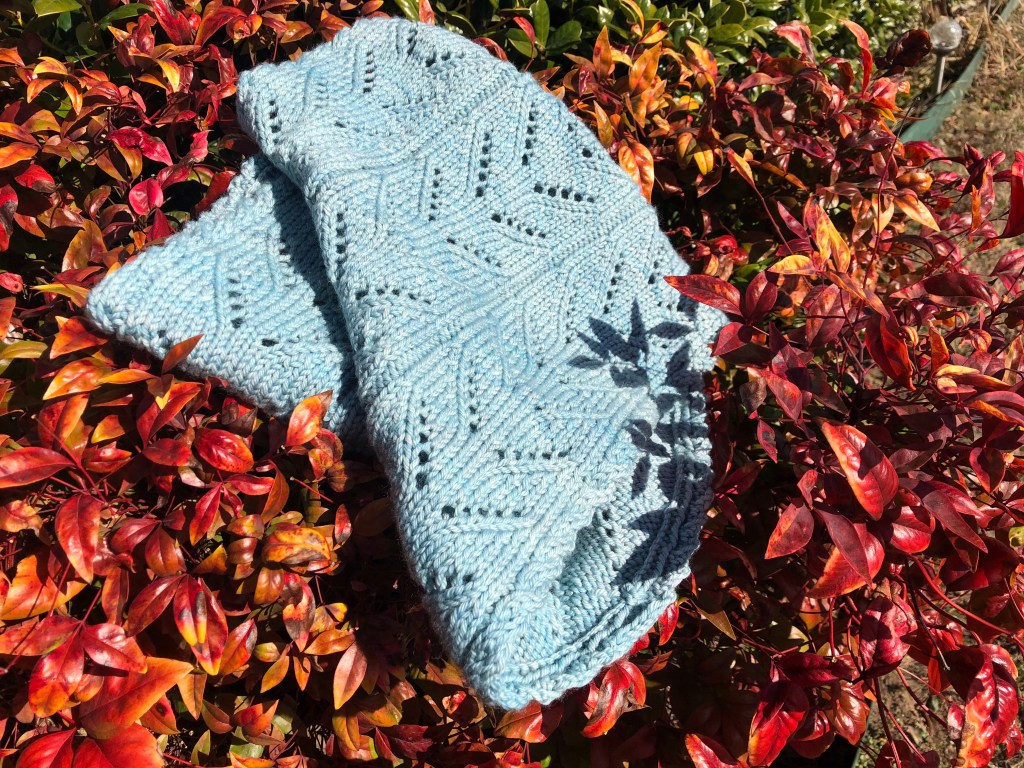
Touch of Yak in Waterlily in a warm light Pattern: Mirror Cable Mitts on ravelry
Performance
This yarn knitted up fine. It wasn’t anything special, but it wasn’t terrible to work with. When I transferred stitches to form cables, the yarn was annoyingly splitty, but plain knitting was fine. The stitch definition was fine for cables and the finished project looked nice.
There’s really nothing to point out if you treat this like any decent acrylic. The yak is nowhere to be found, especially if you’ve worked with 100% yak fiber before. If you haven’t, you might be able to convince yourself this yarn is softer than another mid-range acrylic, but really, it’s not anything special. There is a slight halo of potential yak fiber if you squint. Maybe?
Blocking
This yarn is 90% acrylic, so block it as such. Too much heat will “kill” the acrylic and freeze it in place. “Killing” acrylic is literally melting the plastic it is made of. You’ll achieve a great drape with this but lose any other properties acrylic might offer.
Careful steam blocking is my blocking method of choice for all yarns, even acrylics, but you should make sure you do not leave your steamer in one location for too long.
Touch of Yak in Water Lily wound into a cake
Final Thoughts
This yarn is fine. That’s it. It’s fine. The “touch” of yak is barely noticeable. It feels like almost any other mid-range acrylic. It’s soft, it works, it’s machine washable, and even though it says not to, it really is machine dry-able. The color range is limited, and the yarn is now on clearance. If you like a slightly softer than normal acrylic and you snatch it up, this could be a good yarn for you provided you aren’t picky about colors. Just don’t expect anything that actually touched a yak when you purchase this.
I give Lion Brand LB Collection Touch of Yak a 2 out of 5 score.
Have you used Lion Brand Touch of Yak before in your machine knitting? What about in your hand knitting? What kind of projects did you use it for, and what did you think of its performance?
Are there other properties you think I should include in my yarn reviews? What yarn should I review next? Let me know in the comments!
Hello all, and here’s to another happy day of knitting!
Did you see last month’s free hand-knitting pattern, the Sarah in Lace cowl? I am so grateful for all of the wonderful feedback I’ve received about this piece.
Thank you all for your support!
This month, it’s the machine knitting version’s turn!
Sarah in Lace – Machine Knitting Version
Ideal for hand dyed or natural yarns with slight color gradient, this cowl will let the yarn speak for itself. Cables on each side create a scalloped, slightly rolling edge without allowing the normal roll of stockinette stitch.
The simple lace repeat is suitable for beginners familiar with the latch tool and transfer tools.
The length and width are easy to modifyโjust add lace repeats to achieve your desired size, but note that adding repeats will require more yarn.
Gauge is not vital to this project, but you do not want a tight fabric.
This is the machine knitting version of this pattern.
Visit this post if you’re looking for the hand-knitting version.
Written and Charted Instructions
The lace chart and simplified instructions are on one page (page 5) to be printer-friendly for more experienced knitters, and detailed written instructions for newer knitters follow.
In the written instructions section, I take you step-by-step through the first lace row and the first cable row. The other lace and cable rows build off of those techniques, but are not explained in detail, needle number by needle number.
Decrease Choices
Like its hand-knitting sister, this PDF pattern contains modification tips to help you really make this piece your own.
There are different choices of decreases with instructions for each.
On the left, you’ll see the original decrease intended for the pattern. The detailed row instructions in this pattern assume you are using this decrease.
The yellow sample pictured on the right shows two other decrease options-one on the left of the sample and one on the right. Instructions are provided for this decrease in the pattern notes but not the detailed row instructions like the original decrease.
Pattern Repeat Tip
Mark it up!
Use a set of wet erase markers like Expoโs Vis-ร -Vis markers (non affiliate link) to denote cabled stitches, purl stitches, or central stitches of the lace pattern repeat on the bed of your knitting machine. This can help you remember where to start each lace repeat, which stitches to ladder down to latch up as purl, and which direction cable crosses should go.
In this picture, I’ve used an “X” across two needles to denote the center of the lace pattern repeat’s “V” shape. A bullet marks the needle that I need to ladder down and latch up purl stitches on, and diagonal arrows and “CC” for “cable cross” remind me which direction the four-stitch cable over those needles needs to go.
Wet erase markers work great for any project with pattern repeats and are easy to remove once you’ve finished. Have you given them a try yet?
This pattern is available to non-Ravelers, too, so donโt worry about signing up unless you want to. download now
As always, please contact me if you find anything missing or notice an error in my patterns. I will correct them ASAP.
Thanks for coming on this machine knitting journey with me! If you like what you see and want to help me bring more machine knitting content, please consider supporting me on Ko-fi.
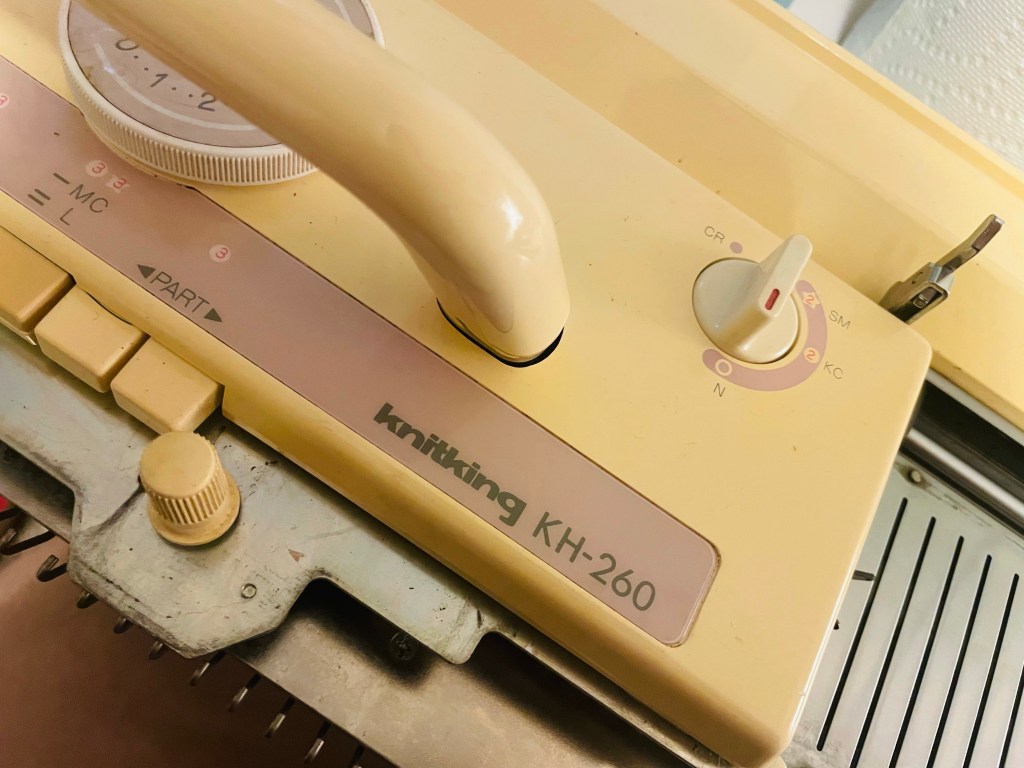
Meet one of my newest machines, the Brother/KnitKing KH-260. It’s a 9mm bulky gauge metal bed machine with punchcard capabilities that can do fair isle, punch lace, tuck, slip stitches, and more. With the right attachments, you can knit intarsia colorwork and ribbing.
This machine was definitely on my WANT list, and my mentor saved it for me when it came to her after its owner passed away.
I don’t know much of this machine’s history other than it was said to be well used and loved. I don’t know how long it sat in storage or where its missing bits are, but I’m happy to have it in my growing (although don’t tell that part to my family) machine collection.
This series isn’t really a tutorial, more of a progress log, but I’ll include links to resources I’ve used along with descriptions of my process and things I’ve learned along the way. Things might be a bit jumbled since this is my first true restoration and I don’t know some of what I’ll need to know yet, but I hope you enjoy it, and I hope you learn something fun and interesting along the way.
Welcome to my first restoration project!
Before I began cataloguing what I had, I went to MachineKnittingEtc.com to find PDFs of the instruction manual, the parts list, and the service manual for this model. (The site is an amazing resource, so be sure to take some time to browse it. It isn’t just instruction manuals, as you can see in this brief overview post.)
This lovely machine doesn’t look much different than what she did out of the box other than her yellowed color. ABS plastic normally yellows due to time, UV exposure, and bromine in the plastic’s composition. That’s just cosmetic, and it’s to be expected for a machine around 30 years old. There are ways to bleach the plastic, but it will re-yellow with time, and the plastic bleaching process could potentially weaken it. There’s nothing wrong with yellowing.
This baby is missing a few parts, though. The rod of the tension mast is missing along with the take-up spring (the antennae-like part) of the mast. The yarn-holder part of the tension mast seems to be part of a color changer with four yarn hole options and not the two-holed part that came standard with the machine. The needle bed number-marking sheet is present but not attached, and most of the accessories are missing.
Fortunately, those parts are generally inexpensive and fairly easy to find and replace on eBay or Etsy. For the accessories, I can just borrow them from my other bulky machine, the Brother KH-230.
With parts catalogued and manuals in hand, it was time for a clean.
This poor girl was dusty. I used LPS-1 wipes to remove most of the dust and grime from the needle bed and used a can of the same chemical to spray down the carriage after carefully removing the plastic casing. I used tweezers to remove what dust bunnies I could and waited for the LPS-1 to reveal more.
You can definitely use the LPS-1 from the spray can with a non-lint cloth to wipe dust and grime away, but I bought a few wipes to try them out and to reach the free shipping threshold. (We Millennials do love our free shipping, after all.) I bought mine from EMI Supply (non-affiliate link).
If there’s one thing I’ve learned so far about knitting machine cleaning, there is always more dust or grease somewhere. Once you spray a machine down with LPS-1, the buildup just starts seeping out of every crevice.
The carriage tuck button was stuck due to gunk and grime, so I used a few drops of Marvel Mystery Oil to help that get moving. That stuff works miracles.
I learned how to clean knitting machine carriages from this Answer Lady Ask Jack video. I recommend watching all of their videos if you have an interest in machine knitting maintenance and repair!
After replacing the sponge bar with a new one and borrowing the tension mast and accessories from my Brother KH-230, I set up the KH-260 for plain knitting.
Things were going well until I attempted patterning with a punch card.
As you can see from my Instagram clip, there’s something pretty wrong with my punchcard unit!
One pass of the carriage resulted in way too many row advances of the punchcard.
And the needle selection? That was a mess, too. Some needles in the center of the 24 stitch pattern never selected.
Let me back up a bit.
Since plain knitting was fine, I went straight to patterning with tuck stitch with plans to go to skipstitch afterwards because I saw on someone’s Instagram post (I’ll update with a link if I can find it again!) that tuck and/or skip stitches really show what a machine can do and point out any faults in its performance.
I removed the test knitting from the needle bed and took the sinker plate off of the carriage so I could see the movement of the needles clearly. (You can do this to find the center of a pattern or where the repeat starts when your machine is working normally if you want to be precise about pattern placement.)
After that, I took off the card stop lever knob and panel covering the card reader unit on the right side of the machine.
I used a small screwdriver that came with a nail polish display rack kit, so I’m not sure what size it was other than perfect for knitting machine maintenance. I will figure out the screwdriver size and update later with details.
As seen in the picture below, the card reader has cracks in the rotary cam (the ivory colored barrel-shaped part). These cracks are likely due to expansion and shrinkage from being stored in a hot attic or garage. There are also cracks along the opposite side.
The plastic direction indicator piece that shows which direction the carriage goes was broken and had disappeared into the void of the machine. The timing belt guide plate to the right of the rotary cam is very loose (as you’ll see in the second video embedded above with my Instagram post). I’m not sure if it’s supposed to be that loose, but I did end up removing it and replacing it as one of the screws holding it was barely in its designated hole.
I used long tweezers from my nail art kit to help me position the screws. Definitely add a pair of these to your machine knitting kit when you can. They’ve been incredibly handy in fishing for dropped parts or reaching into tight spaces.
According to the maintenance manual and Ask Jack videos, the timing belt seems to be timed correctly, so that is a bit of a relief, but I’m not quite sure what to do next. The looseness of the timing belt guide plate seems to be a problem. Placing my hand on it so that it can stop the turning of the punch card clutch gear seems to solve the issue of the card reader turning too many times, but only in one direction.
The carriage also makes a loud CLUNK as it passes across the needle bed when it is in patterning mode. That’s not right, either.
At this point, I don’t know enough about knitting machine maintenance to fix the patterning issue, so I’m actively reading through parts and service manuals, Ask Jack articles, and old forum posts to learn more.
My standard gauge Brother KH-890 machine also has a punchcard unit, so I plan to remove the panel and watch how that machine works in hopes they are similar enough for me to find a clue on how the KH-260 should behave. The loose timing belt guide plate might not actually be an issue.
While I’m figuring out what to do about the punchcard unit, I’ve removed all of the needles from the needle bed for a quick wipe down with LPS-1, and I’ll use needle-nose pliers to straighten any that are bent. I’ll also straighten a couple crooked gate pegs at the end of the needle beds.
I keep all of the needles, screws, and miscellaneous pieces in the same glass jar so nothing will be lost. Now all I have to do is keep my cat away from the jar and we’ll be in a good place regarding loose pieces!
Progress So Far
Problem
Action
Completed
Missing Accessories/Tension Mast Parts
Buy on eBay or Etsy
Dirty Carriage
LPS-1 and Marvel Mystery Oil cleaning
Dirty Needle Bed
LPS-1 Wipe Down
Dead Sponge Bar
Install replacement
Missing Punchcard Indicator Piece
Buy Replacement/Install
/ X
Cracked Rotary Cam
Determine if it works as is or needs to be replaced
Loose Timing Belt Guide Plate
Determine if it’s a problem- Watch KH-890
Needles Not Patterning Correctly
Inspect Card Feeding Unit and Needle Selecting Units, then ???
Punchcard Reader Turning too much
Inspect Card Feeding Unit and Needle Selecting Units, then ???
Carriage CLUNK
No. Idea. Blame the Punchcard Unit?
Crooked Needles
Remove and straighten with pliers
Crooked Gate Pegs
Straighten with pliers
I have a lot left to learn, but there are still things I can do at my current skill level. In between internet sleuthing sessions, I’ll be straightening needles and hunting dust bunnies.
And despite that list of problems, this machine still works. I can still do those fancy skip and tuck stitches, but I’ll have to do the needle selection myself. Being a bit of a lazy knitter, that is less than ideal, but I can still use this wonderful machine.
Thanks for coming on this knitting machine repair journey with me! I’m so excited to learn more about knitting machines through restoration. If you have any tips, tricks, or experience to share, be sure to leave a comment below or email me through the contact page!
There are so many wonderful machine knitting resources floating around on the internet, but theyโre not always easy to find. Theย Resource Roundupย series goes through the links on theย Helpful Links and Resourcesย page in more detail to help you discover new places to learn more about machine knitting.
What is Machine Knitting Etc?
Machine Knitting Etc is the best place to find FREE knitting machine manuals and other PDF resources. If your machine didn’t come with a manual or yours is damaged, you’ll likely be able to find a copy here, even if it isn’t one of the more well-known brands like Brother or Passap.
For the DIY knitting machine mechanic, you can often find parts and service manuals.
If you’re looking for a punchcard pattern, you’ll find copies of standard punchcard sets, such as the “M” series that came with the Brother KH-890, along with sets from other brands and models.
And that’s still not all! You can find various stitch dictionaries, tip and technique articles, and …
Vintage magazines!
Some of the color choices may seem questionable now, but the vintage magazines Machine Knitting Etc host on their site are wonderful sources of patterns and inspiration.
Those 80s and 90s magazines sure boast some familiar looks to what some stores are hanging on their racks now. Classic shapes are classic for a reason, after all!
Many patterns offer schematics so you don’t need to worry about anything being written for a long-discontinued yarn. Simply fit your yarn’s gauge to the pattern, and you’re ready to go after a little math.
I could drone on and on about this wonderful site, but I hope you’ll take some time for yourself to explore it. These manuals and magazines are snippets of machine knitting history, and you never know where your next project might come from!
Please consider adding Machine Knitting Etc. to your ad-blocking software’s white-list so we can support this valuable resource to our craft!
Do you have a resource to share? Comment below or send it to me via the contact me page!
Lion Brand Yarns are commonly found at big box general stores and big box craft stores. You can easily browse their selection on their website, which also features free patterns. The price you see on Lion Brand’s website might not be what you pay in stores, especially since big craft stores like Michael’s and JoAnn regularly run yarn specials and feature coupons with up to 40% off.
I used five or six different Lion Brand yarns over a decade ago as a beginning hand knitter and didn’t really care for them, so I moved on. Recently, Lion Brand bought luxury coned yarn company Silk City Fibers (see my review of their Cotton Bambu yarn in this post), so I decided to order a variety of yarns from the Lion Brand website to give them another try.
They now have many different fiber types and blends from wool to yak fiber along with recycled fibers and an eco-friendly cotton version. Their selection has really widened and diversified compared to what they had when I considered them just a cheap yarn company back as a beginner.
Acrylic yarn is what I think of when I think of Lion Brand, so I decided to give one of their acrylic multicolor yarns a try first. Here’s the scoop on
All opinions are honest and my own. I am not affiliated with any company or individual mentioned or linked unless otherwise noted. I purchased this yarn myself and did not receive compensation for this review.
Lion Brand Ice Cream Big Scoop in Tutti Frutti
About Lion Brand Ice Cream
Fiber Content
100% Acrylic
Yardage
394 or 1117
Ounces
3.5 or 10
Yarn Weight
3 / Light / DK
Made in
Turkey
Availability
Online, Big box craft stores
Put up
skein
Lion Brand Ice Cream comes in two skein sizes, 394 yards for $4.99 MSRP and “Big Scoop” at 1117 yards for $13.49. The smaller size comes in 20 multicolor varieties while Big Scoop comes in 22. The colorways remind me of Dippin’ Dots flavors, and reading the names while hungry is not a good idea!
If you don’t feel like doing the math, that’s about $0.01 per yard at MSRP, and you can frequently find skeins for less at stores like Walmart and JoAnn. If you’re looking for an inexpensive and colorful project, this could be the yarn for you.
Care Guide
Hand Wash
Yes
Machine Wash
Yes
Flat Dry
Yes
Machine Dry
Yes
When it comes to ease of care, it’s hard to beat this yarn. Throw it in the wash with whatever you happen to be washing that time, and the yarn can take it, but don’t iron it or steam it excessively unless you mean to kill the acrylic.
The yarn really softens up in the wash and achieves a bit of drape. I have not used this yarn enough to comment extensively on longer-term wear, but I could see pills forming readily by the fuzz it gained in the wash along with the pills already present in the skein when I wound it into a cake to work with it.
Lion Brand Ice Cream in Tutti Frutti wound into yarn cakes
Knitting Machine Compatibility
4.5mm Standard Gauge
Yes, But*
6.5mm Mid-Gauge
Yes
8mm / 9mm Bulky Gauge
Yes
This yarn can work at upper tensions on standard gauge machines, but they may not be happy about it. It is much more appropriate for mid-gauge machines or bulky gauge at lower tensions.
Swatches, Performance, and Blocking
If youโre curious about how I swatch yarn, please read this post.
It was not a pleasant experience to use Lion Brand Ice Cream on my standard gauge Brother KH-890. My machine didn’t struggle, but knitting with this yarn did not flow like a nicer, smoother yarn would have. My machine did not behave itself at all when I started trying to knit a tuck stitch with a punch card, and after troubleshooting weights, yarn feed, sponge bar, bent needles, and everything else I could think of, I think I have to blame the yarn.
Ice Cream is slightly fuzzy, and my skein came with pre-made pills that liked to catch on the needles. The yarn is not slick, yet it is not scratchy like acrylic “grandma yarns” from years ago or extremely cheap Red Heart acrylic yarn you can find at Walmart. It sits somewhere in the middle that you can be pleased with when you consider its affordability.
All those standard gauge issues aside, Ice Cream worked just fine on the mid-gauge SilverReed LK-150 and Bulky KH-260. I did experience issues with pills catching things occasionally, but for the most part, I didn’t notice any substantial issues.
Lion Brand Ice Cream in Tutti Frutti
Standard-gauge Brother KH-890 stockinette stitch swatch at Tension 10, washed cold on gentle, dried on low*, and gently steamed:
Before
After
40 stitches
6.25″
6.5″
60 rows
7.25″
6.75″
*This yarn can be washed and dried at much hotter temperatures, but I throw my swatches in with whatever loads need to be done unless they have special care requirements.
I noticed about an half inch of vertical/row shrinkage on my swatch, but I did have some growth stitch-wise/horizontally. Since many of my test yarns and swatches shrink vertically in the wash, I suspect it could have something to do with how I set my stitches after knitting them, so I’ll be sure to test that at a future date.
Ice Cream makes a pleasant fabric. My swatch had a decent amount of drape in it from washing and drying alone.
Pattern Ideas
The gentle colors of this yarn and the easy care scream “baby gifts” to me. I think this yarn is a great choice when making items to gift to busy parents-to-be. Who wants to read a care label when the baby is crying?
I originally planned to feature a tuck baby blanket in this post, but since my standard gauge machine does NOT like this yarn when patterning, I’ll feature the problem swatch, oddly flat honeycomb bubble rows and all, and save the blanket for a future pattern post when repair parts for a bulky gauge machine I’m restoring arrive next month.
tuck stitch test swatch
If you want to make something similar, use Brother Card 2M, knit tuck for four rows and then knit plain stockinette for two rows.
Comparable Yarn
The Bernat Baby Sport line features another DK weight yarn at the same $0.01 per yard cost. Bernat Baby Sport is about as equally available at big box stores, and you’ll find more colors overall with solids, ombres, and sparkles. Bernat Baby Sport is another “just throw it in the wash and forget it” yarn, and it is slightly smoother with less fuzz than Lion Brand Ice Cream.
Final Thoughts
When it comes to Lion Brand, this yarn is almost exactly what my past self expected from them: cheap acrylic yarn. However, this is a pretty decent cheap acrylic yarn with a collection of adorable colorways. The ice cream themed names and colors are very satisfying.
If you’re making a baby gift, I think this is a good choice. As far as budget baby yarns go, this one ranks high up on my list.
I’m at the age where my friends are having kids, and when I ask them what they’d like, “something easy to take care of” is always the answer, even friends who have been more than willing to hand wash an item in the past. There are a few singletons and a set of twins in family friends’ futures, and one of them will receive a gift crafted from this adorably dyed yarn.
As a (former?) yarn snob, I don’t know if any more Lion Brand Ice Cream is in my future. I just don’t seek out budget yarns like I used to as a poor college student, and I like to search for unusual or uncommon fiber content. I really like to work with my standard gauge machine, and she did not care for this yarn. When you get down to it, Ice Cream is still a cheap budget yarn.
Overall, I give Lion Brand Ice Cream a middle of the road 2.5/5. It’s a good value with cute colorways.
Have you used Lion Brand Ice Cream before in your machine knitting? What about in your hand knitting or crochet? What kind of projects did you use it for, and what did you think of its performance?
Are there other properties or categories you think I should include in my yarn reviews? What yarn should I review next? Let me know in the comments!